
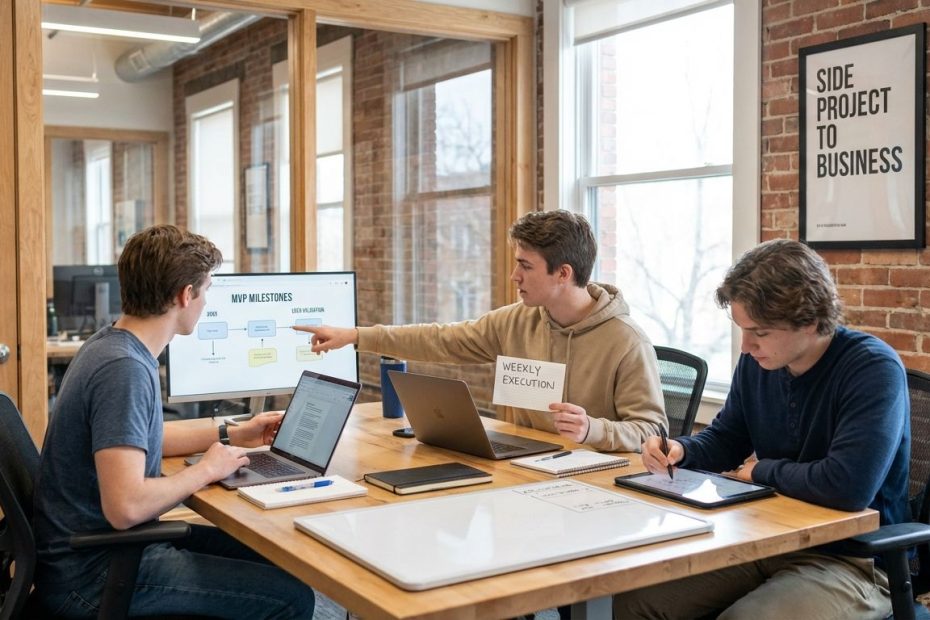
To turn a student side project into a successful business, you need to prove demand with real commitments, ship an MVP that solves one painful problem, then drive repeatable user acquisition before chasing funding. Build it like a weekly operating system, not a one-time sprint, and your project stops being “an idea” and starts becoming a company.
This guide gives you a field-tested path from validation to MVP to first customers to funding, written for students who must execute between classes, exams, and limited budgets. You’ll get practical decision rules, weekly targets, and go/no-go checkpoints that keep momentum high and busywork low. Follow it section by section and you’ll know exactly what to do this week, what to measure, and what to postpone.
How Do You Validate Your Side Project Idea Without Wasting Months Building?
Validation starts when someone pays, signs a pilot, joins a waitlist with intent, or commits time to a real next step. Compliments, “this is cool,” and survey votes don’t count, because they don’t force a tradeoff. The fastest validation method is a narrow promise aimed at a narrow user, paired with one action you can track every week.
Start by defining one target persona you can reach repeatedly on campus: a role, a major, a club officer, a TA, a lab manager, a student employee, a department coordinator. Write down one specific pain that costs them time, money, grades, or reputation. Then schedule 10–20 short conversations focused on workflow and current alternatives, not product opinions. Your job is to confirm three things: the pain is frequent, the pain is costly, and there is already a workaround (even if it’s ugly).
Move from conversations to commitment by running one simple test that forces action. A landing page with one call-to-action (book a call, join a waitlist, request access) is enough to measure demand. A concierge MVP is even faster: you deliver the outcome manually, track how long it takes, and learn what users actually value. If demand is weak, change the audience or the offer before changing the interface. A student startup wins by learning faster than it builds.
Keep a weekly validation scoreboard that avoids vanity metrics. Track: number of qualified conversations, percentage that convert to the next step, and the number of people willing to pilot with a deadline. If these numbers stay flat for two weeks, the issue is positioning, audience selection, or the core promise. Shipping more features won’t fix a product that nobody is pulling for.
What’s The Fastest Way For A Student To Build An MVP (Especially If You Can’t Code)?
An MVP is a testable product that delivers one outcome, not a smaller version of the full vision. Speed comes from choosing a build method that fits the risk you need to remove. If the main risk is “nobody wants it,” a manual MVP beats a coded product every time. If the main risk is “users need a real workflow,” a no-code MVP usually lands in the sweet spot.
Pick an MVP style based on what you must learn next. A manual or concierge MVP proves value with minimal build, and it forces you to understand onboarding and support early. A no-code MVP helps you ship a working flow quickly, often within 1–3 weeks, and it supports real usage tracking. A custom build is justified when you already have repeated demand, or when the product depends on performance, integrations, or data structures that no-code can’t handle.
Execution stays simple when the MVP has hard boundaries. Limit the first release to one user type, one core job-to-be-done, and one measurable success event. Remove everything else, including “nice” dashboards and complex settings. A student team often overbuilds because building feels productive, while selling feels uncomfortable. The MVP exists to make selling easier, because you can demonstrate an outcome, not a concept.
If a technical cofounder isn’t available, treat product assembly as a business skill, not a disadvantage. Use mockups, forms, and lightweight automation to deliver value. Put time into copy, onboarding steps, and the first-run experience, because those determine whether a pilot becomes a habit. A simple MVP with clear activation beats a feature-heavy MVP that leaves users confused.
When Should You Incorporate (LLC Or C-Corp) And Handle IP As A Student?
Incorporate when you must sign contracts, accept money, or join an accelerator that requires an entity. Before that, incorporation often becomes a procrastination trap that burns time and adds paperwork without increasing traction. Early on, the real asset is proof of demand, not a polished legal structure.
Use practical triggers to decide timing. If a customer wants a paid pilot, a university department needs a vendor form, or a partner requests a simple agreement, an entity becomes useful. If you need a business bank account or must issue invoices, incorporation also becomes operationally necessary. If none of that is happening, keep moving with validation and pilots, and document everything in plain language while the product is still changing quickly.
IP needs special attention in student settings because university policies can affect ownership when work is tied to funded research, lab resources, or school-sponsored programs. If the project started in a class, research lab, capstone, or with university equipment, check the school’s tech transfer or IP policy before signing exclusivity or assigning ownership. That check prevents painful surprises later when an investor asks who owns the code, the data, or the invention.
Cap table mistakes are common in student teams because equity feels theoretical at the start. Keep splits simple, write down roles and expectations, and avoid handing out big chunks for vague help. If a contributor is not committing real ongoing time, structure compensation as cash, a small advisory grant, or a milestone-based arrangement. Protect the company’s ability to hire, fundraise, and retain the core team.
How Do You Get Your First Customers While You’re Still In School (And Don’t Have A Network)?
Early customers come from proximity, not popularity. Campus environments give you repeated access to tight communities, shared problems, and fast feedback loops. Use that advantage to win a narrow wedge market before expanding to other schools or broader segments.
Start by choosing a distribution channel you can hit every week without begging for favors. Department listservs, student org partnerships, campus offices, research groups, and cohort-based programs outperform broad social posts early. The goal is not “going viral,” it’s getting a reliable flow of qualified conversations and pilots. A small number of users who rely on the product weekly is more valuable than a large number of downloads that never activate.
Sell a clear outcome-based offer. Students often describe features, when buyers care about results: saved hours, fewer errors, better scheduling, faster approvals, fewer missed deadlines, smoother coordination. Package the pilot as a short, time-boxed program with a defined success metric and a check-in date. When the pilot ends, convert it into a paid plan or a renewed term, and capture a short case study that documents the measurable change.
Make outreach measurable and repeatable. Set a weekly quota: a fixed number of messages, follow-ups, and calls. Keep the message tight: who it’s for, what problem it removes, and the next step. Once you have even one successful pilot, turn it into credibility that shortens sales cycles and lifts conversion rates. That is how a student startup builds momentum without an existing network.
How Can You Raise Funding As A Student And Which Accelerators Are Legit In 2026?
Funding becomes realistic when you can show that users activate, retain, and pay, or at least commit to pilots with clear usage. Investors and accelerators bet on learning velocity and traction signals, not academic credentials. Build leverage by producing proof that reduces market risk.
Accelerators are most useful when they increase speed: better mentorship, stronger distribution, and warmer capital access. One concrete program with published dates is the USC and Techstars Accelerator, with applications opened Aug 25, 2025, final deadline Nov 19, 2025, program running Mar 9 to Jun 4, 2026, and an advertised $220,000 investment plus perks. Use published dates like these to plan your traction milestones backward, so you enter application season with measurable momentum rather than a fresh prototype.
Know what “$220,000” means before celebrating it. Techstars published updated standard terms describing a structure that includes $20,000 via a post-money convertible equity agreement for 5% common stock, plus $200,000 via an uncapped MFN SAFE that converts later. This matters because dilution is not a single number, it depends on later financing, option pool changes, and SAFE conversion outcomes. If you understand the mechanics, you negotiate and plan with confidence instead of reacting under pressure.
Keep the funding sequence clean. Use early traction to get into a strong program, then use the program’s progress to drive a priced round or larger seed SAFE. Keep documentation ready: incorporation when required, basic IP clarity, and a simple investor narrative backed by real metrics. Funding is a tool for scaling what already works, not a substitute for product-market pull.
How Do You Balance Classes With Building A Startup Without Burning Out?
Burnout in student startups usually comes from randomness: long bursts followed by long gaps, constant switching, and no weekly definition of “done.” Fix it with a fixed cadence that fits academic life and still produces compounding progress. A startup can move fast on 8–12 focused hours per week if those hours are structured.
Run a weekly operating schedule with non-negotiables. Reserve one block for user conversations, one block for shipping, and one block for distribution. Protect those blocks like labs or exams, because they are the engine of progress. The startup stays small enough to coexist with school, and strong enough to grow through consistent output.
Use “minimum shippable week” rules to protect momentum. Set a baseline: one meaningful customer touch and one product change that improves activation, retention, or conversion. If that baseline is missed two weeks in a row, cut scope immediately and remove distractions. Being busy is not the goal, shipping and learning is.
Programs built around student schedules can reinforce cadence through workshops, coaching, and demo-day deadlines. Stanford’s Emergence Student Accelerator publicly describes a structure that includes workshops, founder coaching, industry mentorship, and investor connections, which mirrors the cadence that keeps teams accountable. Even without joining a program, borrowing that rhythm improves execution and reduces stress.
Do You Really Need A Full Business Plan Or Is A One-Page Plan Enough To Start?
A one-page plan is enough to start validating, building, and selling. A longer business plan becomes useful when a lender, grant program, or institutional partner requires formal documentation. Early-stage startups win by operating with clarity, not by writing long documents based on assumptions.
Use a two-layer planning system. The first layer is a one-page operating plan: customer, problem, offer, channel, pricing, key weekly metrics, and the next two experiments. This becomes the team’s weekly decision tool, and it stays current because it is easy to update. The second layer is a formal plan you produce only when needed for financing or formal partnerships.
If structure is needed, free resources and templates can accelerate the process. The U.S. Small Business Administration highlights free learning resources, sample plans, and partner templates through SCORE, plus workshops and webinars that help founders write plans when required. Use these resources to produce a plan that supports execution, not a document that sits untouched.
Keep planning tied to measurement. If the customer and pricing are still guesses, the correct move is more interviews, more pilots, and clearer conversion data. Planning becomes valuable when it captures what you already learned and turns it into repeatable operations. That is how the plan becomes a tool, not a task.
The Student Startup Roadmap
- Validate with commitments: waitlist, pilots, pre-sales
- Ship a narrow MVP that delivers one outcome
- Acquire users via repeatable campus channels
- Incorporate when contracts or money require it
- Raise funding after traction is measurable
Build The Business You Can Run This Semester
Student startups succeed when you treat the project as a disciplined weekly system: validate demand, ship a focused MVP, convert pilots into paying users, and expand only after retention is real. Keep legal and planning work tied to real triggers, not anxiety, and you’ll preserve time for the actions that move the graph. Use campus proximity as a distribution advantage, because you can iterate faster than almost any founder outside school. When traction becomes consistent, accelerators and funding conversations shift from speculative to practical. Commit to the cadence, measure what matters, and the side project turns into a business without requiring a gap year or a miracle.
References
- Idea Validation → MVP Development → User Acquisition → Funding | The Full Actionable Roadmap for Non-Tech Founders (Tried & Tested)
- USC and Techstars Accelerator
- Techstars Investment Terms Update (Apr 17, 2025)
- Student Accelerator | Emergence (Stanford)
- Free Resources to Help You Write Business Plan | U.S. Small Business Administration (Published Nov 25, 2024).

Nirdosh Jagota is Managing Partner at GRQ Biotech Advisors with 30+ years in the biotech industry. A former executive at Amgen, Genentech/Roche, Merck, and Pfizer, he has led >25 NDAs/BLAs/MAAs and hundreds of INDs across global regulatory, quality, and compliance.