
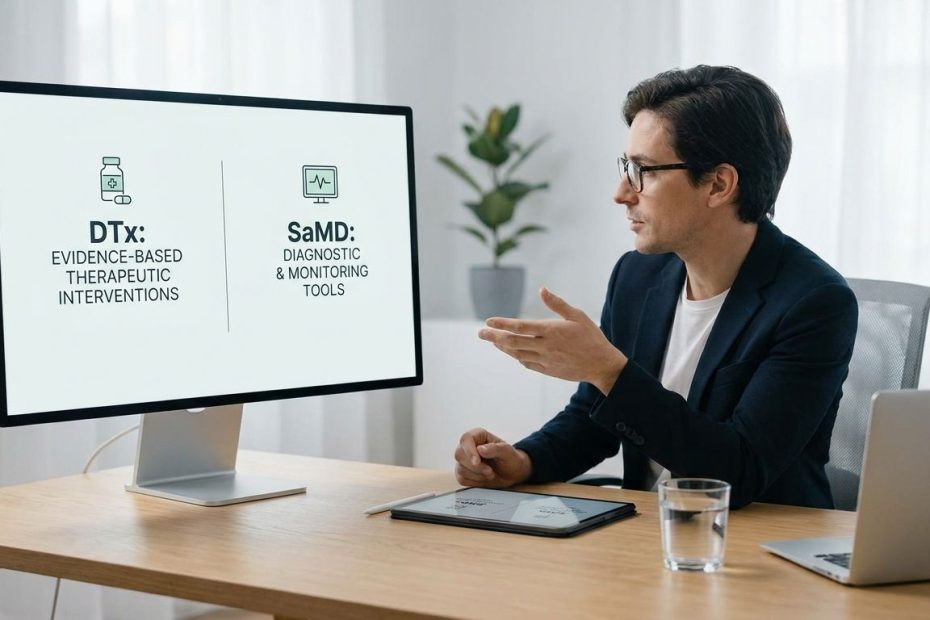
If you work around digital health, you need to separate clinical purpose from regulatory category. Digital therapeutics, often called digital therapeutics, focus on delivering evidence-based treatment or disease management through software, while software as a medical device is a regulatory label for software that performs a medical purpose without being part of a hardware medical device.
That distinction shapes product strategy, clinical evidence, regulatory planning, and your career options. Once you understand where these terms overlap and where they diverge, you can read job descriptions better, evaluate products faster, and position your skills for product, regulatory, clinical, quality, and data roles with much more precision.
What Is The Difference Between DTx And SaMD?
You should think of digital therapeutics, or DTx, as a clinical category. A DTx product is software designed to deliver an evidence-based intervention that treats, manages, or prevents a disease, disorder, or medical condition. The emphasis sits on therapeutic effect, patient outcomes, and proof that the software is doing real medical work rather than offering general wellness support.
Software as a medical device, or SaMD, is different. SaMD is defined by regulators as software intended for one or more medical purposes that performs those purposes without being part of a hardware medical device. That means SaMD can cover far more than therapy. It can include diagnostic support, image analysis, monitoring algorithms, triage logic, and clinical management tools.
The cleanest way to keep this straight is simple: DTx tells you what the software does for the patient, SaMD tells you how the software is classified in regulatory terms. Many DTx products fall inside SaMD, but not every SaMD product is a DTx product. A therapeutic app may be SaMD, yet an imaging algorithm can be SaMD without being therapeutic at all.
This matters when you evaluate products or roles. If a company says it builds DTx, you should expect treatment claims, patient engagement strategy, outcomes evidence, and care pathway thinking. If a company says it builds SaMD, you should expect attention to intended use, device classification, validation, risk controls, and compliance documentation.
Is DTx A Subset Of SaMD?
In many real-world cases, yes, DTx functions operate inside the SaMD category. If software delivers a therapeutic intervention and meets the definition of a device software function, it is commonly handled under the same medical device structure used for SaMD. That is why many teams in digital therapeutics spend so much time on quality systems, clinical evidence, labeling, and product claims.
You should still avoid treating the two terms as interchangeable. DTx emerged as an industry and clinical term focused on software-delivered therapy. SaMD emerged from a regulatory effort to define software with a medical purpose in a jurisdiction-agnostic way. One term is driven by intended clinical value, the other by legal and regulatory boundaries.
This overlap creates confusion in hiring and product messaging. A job posting may ask for SaMD experience when the product is a therapeutic application. Another company may market a product as a digital therapeutic even though the operational work looks very similar to other device software programs. If you can explain that overlap clearly, you instantly sound more credible in interviews and cross-functional meetings.
A practical rule works well here. When you assess a software product, start by asking whether it has a medical purpose. Then ask whether it is delivering a therapy to the patient or serving another medical function. That sequence will usually tell you whether you are looking at SaMD broadly, DTx specifically, or software that never enters device territory at all.
How Do Intended Use And Product Claims Change The Classification?
If you want to understand whether software sits in DTx, SaMD, or non-device software territory, start with intended use and claims. These are not marketing afterthoughts. They shape whether the product is positioned as a wellness tool, a support application, a clinical decision support tool, or a regulated medical product.
When software claims to diagnose, treat, mitigate, cure, prevent, or drive clinical management of disease, you move closer to device regulation. That pushes the product into medical device analysis and often into SaMD territory when the function is not tied to a hardware device. If the same software only claims to support general wellness, organization, education, or administration, the regulatory picture may change sharply.
This is where many early-stage teams make expensive mistakes. They build a product with disease-specific workflows, symptom scoring, intervention logic, and outcome tracking, then write copy that sounds casual and consumer-friendly. Regulators, payers, and sophisticated buyers will still examine the actual intended use reflected in features, instructions, and product behavior, not just headline branding.
You should also pay attention to multi-function products. A single app may contain a mix of medical and non-medical functions. One feature might provide education, another might monitor symptoms, and another might deliver a treatment protocol. Companies have to break those functions apart, assess each one carefully, and document where device oversight applies and where it does not.
Clinical decision support is another line you need to understand. Some decision support software may fall outside device regulation under specific conditions, especially when the intended user is a healthcare professional who can independently review the basis for the recommendation. Patient-facing software usually has a harder time fitting that carveout, which is why therapeutic and patient-directed tools often remain inside medical device review.
How Is DTx Regulated Compared With SaMD?
In the United States, you should not expect a separate regulatory lane labeled digital therapeutics. The Food and Drug Administration, or FDA, evaluates device software functions under the existing medical device structure. If a DTx product meets the definition of a device, it is reviewed through the same broader system used for software as a medical device and related device software functions.
That means your regulatory planning starts with software function analysis, intended use, risk, and claims. It does not start with a special DTx badge. Teams need to determine whether the software function is a device, whether any exclusions apply, what classification fits, what evidence package is needed, and what quality and post-market obligations follow from that decision.
This is one of the biggest career-relevant truths in digital health. A lot of people enter the field thinking DTx is a separate regulatory profession. It is not. If you work in regulatory affairs, quality, clinical affairs, or product compliance, you need fluency in software device regulation, not just familiarity with the DTx label.
You also need to understand that software regulation often happens function by function. A company may ship one platform with monitoring, educational, coaching, data visualization, and intervention modules. Some of those functions may be regulated, some may not. Strong regulatory professionals know how to decompose the product, connect each function to applicable policy, and prevent claim drift during commercialization.
That discipline matters just as much for product managers and clinical leaders. If you overstate a software capability, you can trigger a very different regulatory burden. If you understate it, you may weaken your value proposition with providers, buyers, and payers. The strongest teams align claims, evidence, labeling, reimbursement strategy, and user experience from the start.
What Evidence Standards Matter For DTx And SaMD?
You should expect evidence to matter in both categories, but not always in the same way. SaMD commonly relies on a clinical evaluation model that looks at clinical association, analytical or technical validation, and clinical validation. In practical terms, you need to show that the software is built correctly, performs as intended, and produces clinically meaningful output in the intended setting.
DTx tends to carry stronger expectations around patient outcomes because the product is framed as an intervention. If your software says it treats insomnia, supports substance use disorder care, or manages symptoms through a therapeutic protocol, buyers and clinicians will look for proof of therapeutic benefit, not only proof that the software runs correctly. That often pushes teams toward stronger clinical study design and more visible outcomes reporting.
You should also recognize that engagement is part of the evidence story in digital therapeutics. A therapeutic algorithm means little if patients do not use the product as intended. Adherence, persistence, completion rates, user comprehension, and behavioral design all affect whether the intervention works in routine care. That is one reason DTx work often pulls together clinical science, product design, behavioral medicine, and data analytics more tightly than many other software categories.
For many SaMD products outside DTx, the central proof may be diagnostic accuracy, triage performance, workflow safety, or prediction quality. For DTx, the bar often extends to symptom change, condition management, real-world utilization, and outcome durability. When you interview for clinical, product, or evidence roles, being able to state that difference with precision gives you a sharp advantage.
Another point matters here. Evidence is not only a submission problem. It affects payer acceptance, provider adoption, formulary decisions, employer contracting, and care pathway integration. A product with clean technical validation but weak patient outcome data may satisfy one audience and fail with another. You need to evaluate the full evidence stack, not just the minimum regulatory file.
What Are Real-World Examples Of DTx And SaMD?
You can understand the overlap fastest by looking at common product types. Prescription digital therapeutics have included software-based interventions aimed at conditions like substance use disorder, opioid use disorder, insomnia, and attention-related conditions. These products are typically patient-facing, condition-specific, and built to deliver a measurable clinical intervention rather than general coaching or information.
Those examples sit comfortably in the DTx conversation because the software is the intervention. The user is not just logging data or receiving reminders. The software is delivering a treatment program, behavioral protocol, or therapeutic sequence that is intended to change a clinical outcome. That is what makes digital therapeutics distinct from ordinary health applications.
SaMD examples extend much wider. Software that analyzes radiology images, flags possible stroke, predicts deterioration risk, assists diagnosis, prioritizes cases, supports medication review, or monitors patient data for clinical action may all fit the SaMD concept if the intended medical purpose is present and the software is not merely part of a hardware device. These products may never claim to be therapeutics, yet they still sit squarely inside software regulation.
You should also notice where confusion starts in the market. A symptom tracker may look clinical but remain outside device oversight if it stays within narrow non-device bounds. A behavior-change app may sound like a wellness product until it makes disease treatment claims. A monitoring tool may become much more regulated once it triggers clinical decision pathways. Product language, instructions for use, and actual software function matter more than glossy branding.
If you work in product, business development, or investment research, these distinctions help you separate genuine medical software from loosely labeled digital health products. That saves time. It also helps you evaluate whether a company is building a reimbursable, clinically integrated product or simply repackaging consumer software with medical language.
Why Does The DTx Vs SaMD Distinction Matter For Your Career?
This distinction matters because it points you toward different skill stacks. If you want to move into regulatory affairs, quality assurance, design assurance, or compliance, SaMD fluency is the stronger anchor. You need to understand intended use, software classification, risk management, validation, human factors, clinical evaluation, and post-market obligations.
If you want to work in clinical product strategy, care model design, medical affairs, or market access, DTx becomes more important. You need to speak the language of therapeutic mechanism, patient adherence, behavior change, outcomes evidence, provider adoption, reimbursement, coding, and payer scrutiny. Those teams care less about software buzzwords and more about whether the intervention changes patient care in a measurable way.
For product managers, the sweet spot is often at the overlap. You need enough SaMD understanding to keep claims, workflows, and documentation aligned with regulation. You also need enough DTx understanding to shape a product that earns trust from clinicians, patients, and buyers. Product leaders who can bridge those worlds are much harder to replace.
Data science and artificial intelligence roles also sit in that overlap. Many machine learning tools are built as SaMD, particularly in diagnosis, triage, image analysis, and clinical support. DTx teams also use analytics to improve adherence, personalize pathways, and measure outcomes. If you want to be career-relevant in this space, your technical skill set needs to connect with validation, data governance, clinical utility, and safety controls.
Commercial roles benefit too. Sales, partnerships, and market access leaders who understand the difference between DTx and SaMD can qualify deals faster, shape cleaner messaging, and avoid overpromising. They can explain why one product fits provider workflows, why another needs stronger evidence, and why a buyer may ask for a very different package of proof depending on whether the software supports diagnosis, management, or treatment.
Which Skills Should You Build If You Want To Work In This Space?
You should build a core vocabulary that spans regulation, clinical evidence, product development, and reimbursement. At minimum, learn intended use, indications for use, software function analysis, risk classification, validation, clinical evaluation, human factors, real-world evidence, and post-market surveillance. If those terms feel natural to you in conversation, your credibility rises fast.
You also need document fluency. Hiring managers in this field value people who can read guidance, summarize requirements, trace claims to evidence, and identify gaps between product behavior and regulatory positioning. That does not only apply to regulatory teams. Product managers, clinical specialists, and operations leads all benefit when they can translate guidance into execution.
Clinical literacy matters more than many candidates expect. You do not need a clinical degree for every role, but you do need to understand disease pathways, endpoints, workflow implications, patient adherence issues, and what counts as a meaningful outcome. DTx especially rewards candidates who can connect software design with measurable therapeutic effect.
For technical roles, validation discipline is essential. You should know how technical performance differs from clinical performance, why dataset quality matters, how labeling limits use, and why model performance on a test set does not guarantee safe clinical use. If your technical work can survive contact with regulatory review and real clinical workflows, you become far more valuable.
You should also learn reimbursement basics. Many strong products fail commercially because teams ignore coding, coverage, benefit design, and payer evidence expectations. A DTx career path in particular benefits from understanding how a therapy gets paid for, who prescribes it, who monitors it, and how outcomes connect to contracting strategy.
How Should You Position DTx And SaMD Experience On Your Resume?
You should avoid vague phrases like digital health enthusiast or medical app experience. Hiring managers want proof that you understand regulated software, clinical evidence, and commercialization realities. Your resume should show where you handled product claims, validation planning, design controls, clinical study support, risk analysis, payer evidence, or provider workflow integration.
If your work was closer to SaMD, say so in operational terms. Mention software function analysis, intended use documentation, verification and validation support, quality management activities, usability testing, traceability, complaint handling, or clinical evaluation inputs. That language signals that you understand how regulated software gets built and maintained.
If your work was closer to DTx, highlight outcome-oriented contributions. Mention therapeutic intervention design, patient engagement metrics, adherence optimization, study endpoints, care pathway integration, digital biomarker use where relevant, reimbursement support, or provider adoption work. That tells employers you understand software as treatment, not just software as product.
You should also be precise when your experience sits outside true DTx or SaMD. There is no value in overstating a wellness application as a therapeutic or regulated medical device project. Sophisticated interviewers will test that claim quickly. Clear, accurate positioning earns more trust than inflated terminology.
Portfolio materials can help you stand out. Build a comparison matrix showing DTx, SaMD, and non-device software distinctions. Write a short memo analyzing intended use and evidence needs for a sample product. Map one product feature set to likely regulatory and clinical implications. Work like that shows hiring teams you can think beyond buzzwords and operate at decision level.
What Misunderstandings Should You Avoid?
You should not assume every health app is a digital therapeutic. Most are not. Many wellness, coaching, tracking, and engagement tools never reach the level of evidence-based therapeutic intervention required for credible DTx positioning.
You should not assume every medical software product is a digital therapeutic either. Plenty of software products are medical devices without delivering therapy. Diagnostic tools, monitoring systems, imaging software, and clinician support systems may all qualify as SaMD without being therapeutic interventions.
You should not assume DTx means easier regulation. In many cases, a product that makes treatment claims faces serious evidence and implementation demands. Therapeutic positioning can increase expectations from clinicians, payers, and buyers, even when the software sits inside existing device frameworks.
You should not assume SaMD is only a regulatory concern for legal teams. Product, engineering, clinical, design, quality, and commercial teams all affect how a software product is classified and evaluated. Claims, user interface choices, instructions, and workflow triggers can alter the regulatory picture quickly.
You should not assume career value comes from memorizing definitions alone. Employers look for applied judgment. They want to see whether you can read a product, identify regulatory and clinical consequences, and help a team make better decisions before those decisions become expensive mistakes.
What Is The Quick Difference Between DTx And SaMD?
- DTx is software that treats, manages, or prevents a medical condition through an evidence-based intervention.
- SaMD is software with a medical purpose that is not part of a hardware medical device.
- Many DTx products are SaMD, but many SaMD products are not DTx.
Use The Right Term And You Strengthen Your Career Position
If you want to work in digital health at a serious level, you need to use DTx and SaMD with precision. DTx tells the market that the software delivers a therapeutic intervention with meaningful evidence behind it, and SaMD tells regulators and employers how that software fits into medical device oversight. Once you separate those roles, product strategy gets cleaner, evidence planning gets sharper, and job targeting gets easier. You can evaluate companies faster, explain your own experience with more authority, and build skills that match where the field is actually hiring. If your goal is long-term relevance, learn the overlap, respect the differences, and position yourself as someone who can connect regulation, clinical value, and product execution.

Nirdosh Jagota is Managing Partner at GRQ Biotech Advisors with 30+ years in the biotech industry. A former executive at Amgen, Genentech/Roche, Merck, and Pfizer, he has led >25 NDAs/BLAs/MAAs and hundreds of INDs across global regulatory, quality, and compliance.