
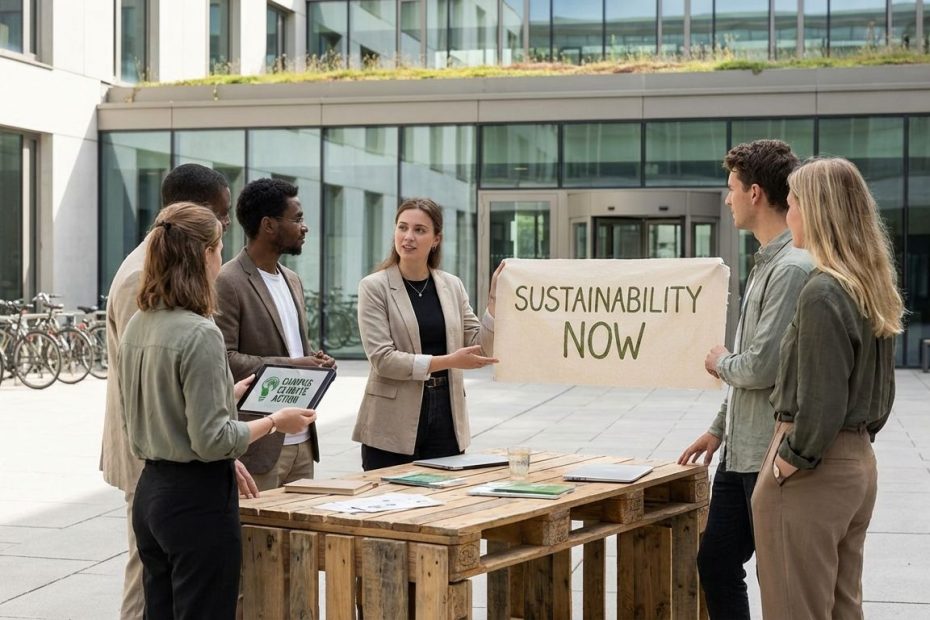
Campus climate activism now reaches far beyond marches and slogans. You can see students shaping university policy, pushing fossil-fuel divestment, building zero-waste programs, influencing curriculum, and turning sustainability from a campus talking point into an operational priority.
If you want to understand where higher education is heading, watch what students are building, funding, measuring, and demanding. This article breaks down how campus climate action works today, where student pressure is producing real institutional change, and what these shifts mean for universities, sustainability teams, and the students who want more than branding.
What Does Climate Activism On Campus Actually Look Like Today?
Climate activism on campus now includes protest, policy work, research, student government organizing, peer education, food-system reform, waste reduction, and investment pressure. If you still picture campus activism as a rally on the quad followed by a petition, that view is outdated. Students now operate inside formal university channels as often as they organize outside them, and that shift has made climate action harder for institutions to ignore.
You can see this in the way many universities have folded student energy into climate fellowships, sustainability councils, green revolving funds, public reporting systems, and academic programs. The Sustainability Tracking, Assessment and Rating System, often called STARS, gives colleges a structured way to report sustainability performance while also drawing students, faculty, and staff into the work. That matters because it turns activism into a force that can influence planning, budgets, procurement, operations, and public accountability.
The University of California system offers a strong example of how student pressure can move into formal leadership channels. Its sustainability reporting points to long-running student involvement and climate fellowships that support student-led work in decarbonization, resilience, and environmental justice. When a campus pays students to design projects, gather data, and build solutions, activism stops being treated as a side issue and starts becoming part of how the institution functions.
You also see a practical shift in the kinds of projects students choose. Many organize campus thrift programs, repair events, compost systems, food recovery partnerships, bike advocacy, building-efficiency campaigns, and climate education events that connect research with daily campus life. These efforts matter because they make sustainability visible in routines students actually control: what gets purchased, how waste is sorted, how events are run, and how student organizations use their influence.
That blend of pressure and implementation is what defines campus climate activism now. Students still protest when universities stall, but they also draft resolutions, push for procurement reform, review institutional claims, compare their campus against peer schools, and demand measurable targets. A movement that once focused on awareness has become one that tracks outcomes.
How Are Students Pressuring Universities To Divest From Fossil Fuels?
Divestment remains one of the clearest ways students connect climate values to university money. When students demand fossil-fuel divestment, they are asking institutions to stop profiting from industries tied to the crisis they claim to be addressing through sustainability plans, research, and public pledges. That argument is simple, visible, and powerful, which is why divestment keeps showing up across campuses.
Student organizers now use a wider set of tools than they did a decade ago. Referendums, student senate resolutions, trustee engagement, sit-ins, complaint filings, coalition letters, and public data requests have become standard. These tactics matter because they shift the conversation from symbolic protest to institutional accountability, and they force administrators to answer direct questions about endowments, investment screens, donor influence, and governance.
At the University of Illinois Urbana-Champaign, student organizers gained a major public signal when a campus referendum showed strong support for divestment from fossil fuels. Numbers like that carry weight because they move the issue beyond activist circles and demonstrate broad student backing. Administrators can dismiss a protest more easily than they can dismiss a clear vote.
New York University also stands out as a case where sustained student organizing produced a material outcome. Student pressure helped push the institution toward avoiding direct investments in companies primarily engaged in fossil-fuel extraction. That kind of result shows why divestment matters so much on campus: it gives students a visible measure of whether university leadership will align financial decisions with public sustainability commitments.
Some campaigns now go further than divestment alone. Students are questioning research partnerships, financial transparency, and the relationship between university branding and institutional capital. That wider push strengthens the movement because it recognizes that campus climate policy is not limited to energy systems and recycling bins. It also includes where money goes, who shapes strategy, and whether institutional decision-making reflects stated climate goals.
You can expect divestment pressure to remain central because it sits at the intersection of ethics, operations, reputation, and student trust. A university can promote sustainability rankings and emissions targets, but students will keep asking whether its investment choices tell the same story. That tension has made divestment one of the most durable forces in campus climate activism.
Do Student-Led Sustainability Campaigns Actually Change University Policy?
Yes, student-led sustainability campaigns do change university policy, though the process usually takes persistence, data, and institutional fluency. Most policy shifts do not happen after one demonstration or one viral moment. They happen when student organizers connect public pressure to a specific operational demand that a university can measure, fund, and report.
That pattern shows up across higher education. Universities now employ sustainability officers, publish sustainability plans, report progress through campus rating systems, and market climate commitments to prospective students. Those actions do not emerge in a vacuum. They often reflect years of student organizing that pushed sustainability from a niche concern into a standing administrative priority.
The Princeton Review’s reporting on green colleges shows how widespread this shift has become. Colleges featured in its guide report strong adoption of sustainability staffing, sustainability-focused academic offerings, renewable or clean energy use, and waste diversion efforts. Those numbers do not prove that every gain came directly from student activism, but they do show that sustainability now sits close to the center of campus operations, and students helped push it there.
What tends to work best is targeted pressure tied to a specific institutional lever. A campaign focused on building electrification, green revolving funds, procurement standards, dining waste, fossil-fuel screens, or public reporting has a better chance of producing policy than a campaign built on broad language alone. Universities operate through committees, budgets, contracts, and capital plans. Students who understand that machinery tend to move faster from protest to policy.
Harvard’s expansion of its Green Revolving Fund is a useful signal in this broader pattern. When a university commits more capital to decarbonization projects, it shows that climate work is becoming a funding issue, not just a messaging issue. Student pressure often plays an important role in creating the internal urgency that makes those spending decisions politically easier.
Policy change also depends on whether students stay organized after an initial win. A resolution means less if no one tracks implementation. A climate pledge means little if reporting stays vague. The strongest student campaigns now build follow-through into the campaign itself by asking for deadlines, metrics, public dashboards, committee seats, and regular disclosure. That is where activism starts to function like governance.
What Kinds Of Campus Climate Actions Are Students Organizing Besides Protests?
Most campus climate work happens far from a megaphone. Students run food recovery systems, zero-waste event standards, compost programs, reuse markets, bike-share advocacy, green labs campaigns, energy audits, repair events, climate literacy workshops, and peer education programs. These efforts may look smaller than a march, but they often reshape daily campus behavior more effectively.
Food and waste programs are especially common because they are visible, measurable, and connected to student life. Students can pressure dining services to reduce food loss, expand composting, improve labeling, and support local sourcing. They can also build move-out donation drives, clothing swaps, textbook reuse systems, and repair events that reduce waste while making sustainability feel practical instead of abstract.
Athletics and major campus events have also become part of the conversation. Environmental Protection Agency materials for colleges and universities point to opportunities in greener sports operations, waste reduction, and event-based awareness. That matters because campus identity often runs through athletics, and students know that visible sustainability standards at games and large events can normalize better practices across the institution.
Paid fellowships and student project funding have become another major channel. When universities fund student climate work, students can test solutions in buildings, transportation systems, community resilience planning, and operational efficiency. These programs build a bridge between activism and implementation. They also create a pipeline of students who can speak the language of facilities teams, academic leadership, procurement staff, and public reporting.
Students also organize climate action through academics. That can mean pushing for sustainability minors, interdisciplinary climate coursework, applied research opportunities, and community-based learning that connects classroom work to local environmental needs. This kind of organizing matters because it broadens the movement beyond students who identify as activists. Once sustainability enters the curriculum, more students can participate through the work they are already doing.
The most effective campuses tend to combine visible advocacy with durable systems. Protests create urgency. Operational projects create proof. When student groups can show that a compost pilot worked, that a reuse event cut waste, or that a fellowship project identified measurable energy savings, they build institutional credibility without giving up pressure.
How Are Universities Turning Student Climate Anxiety Into Action?
Universities are starting to recognize that climate concern is not just a political issue for students. It is also a daily emotional reality that affects motivation, attention, and a sense of future direction. The campuses making progress are not treating that concern as something to manage through messaging alone. They are giving students work, agency, and visible ways to participate in solutions.
The University of California has been especially clear in linking student concern with student action. Through climate fellowships and related campus initiatives, students are given support to research problems, build projects, and contribute to climate solutions in their own communities. That matters because action changes the student role from observer to participant, and that shift can strengthen commitment, skill development, and resilience.
Coursework has become part of this response as well. Universities are building climate resilience and sustainability education into academic offerings so students can develop practical tools, not just absorb alarming information. A student who can connect climate science, campus operations, public policy, and local implementation is more likely to stay engaged than a student left with concern but no route to action.
Student activism also creates community, and community matters. Campus sustainability clubs, organizing coalitions, and project teams give students a place to turn concern into momentum. The work becomes shared, visible, and social. That reduces the isolation many students feel when climate change is discussed only as a global crisis rather than a local problem they can influence through institutional action.
This is one reason campus climate activism keeps expanding. It offers students a way to align values, education, and career preparation. A student who works on decarbonization planning, waste reduction, environmental justice programming, or campus resilience is not just joining a cause. That student is building experience in policy, operations, communications, data analysis, and institutional change.
Universities that take this seriously gain more than a better sustainability story. They create a stronger educational environment by showing students that learning can produce visible results. When a campus responds to student climate concern with fellowships, measurable projects, transparent targets, and practical support, it turns urgency into capability.
Which Colleges Are Seen As Sustainability Leaders, And Why Does That Matter To Student Activists?
Sustainability leadership matters on campus because rankings, networks, and public benchmarks give students leverage. If a university presents itself as a green institution, students can use that image to demand stronger action on emissions, procurement, transportation, buildings, investments, and accountability. Public recognition creates expectations, and expectations create pressure.
The Princeton Review’s Guide to Green Colleges is one of the clearest examples of how this works. When schools are highlighted for environmental commitment, students and families start to treat sustainability as part of institutional quality, not an optional bonus. The same reporting has shown that a large share of students consider a college’s environmental commitment when deciding where to apply or enroll. That turns sustainability into a competitive issue for admissions, branding, and reputation.
Second Nature’s Climate Leadership Network adds another layer. By joining a network built around climate commitments in higher education, institutions place themselves in a public comparison set. Students can then ask whether their university is actually meeting the standard suggested by its membership, pledges, and public language. A network badge may help a university market itself, but it also gives student activists a benchmark to reference when they want faster action.
The Association for the Advancement of Sustainability in Higher Education, which operates STARS, plays a similar role. Reporting systems matter because they make claims easier to test. Students can compare their campus to peer institutions, review categories where performance is weak, and identify where the gap between rhetoric and results is widest. That kind of comparative pressure is one reason sustainability reporting has become so useful to student organizers.
Leadership also matters because it shows what is possible. If one campus can install stronger clean energy targets, build funded fellowships, improve waste diversion, or adopt stricter investment policies, students at another campus can point to that progress and ask why their own institution is lagging. Peer comparison has become one of the most effective arguments in campus sustainability work because university leadership teams care about rankings, reputation, and public credibility.
You should read green leadership claims with some discipline, though. A school can perform well on selected metrics and still face criticism over investments, construction decisions, labor issues, or slow implementation. Student activists often understand this better than anyone else. They use rankings and sustainability honors as a starting point for accountability, not a reason to stop pushing.
What Are Students Saying In Real Campus Communities About Sustainability Efforts?
In campus communities, students usually speak about sustainability in practical terms. They ask where to find a climate club, whether the administration follows through, which offices control funding, and what projects actually need volunteers. The language is less polished than a university press release, but it is often more useful because it points straight to lived campus reality.
Student discussions also show that sustainability credibility is earned locally. Students want to know whether recycling bins are labeled properly, whether composting exists beyond a pilot, whether dining services reduce waste, whether transit is usable, and whether green construction claims match what they can actually see. When students question university sustainability messaging, they are usually reacting to a gap between formal branding and daily experience.
Online campus discussions reveal another important pattern: many students want easy entry points, not just ideological alignment. They are looking for projects they can join quickly, whether that means a cleanup event, clothing swap, youth climate summit, garden build, repair workshop, or student government campaign. That matters for organizers because participation grows when the path into the work is visible and immediate.
There is also skepticism, and that skepticism is healthy. Students often ask whether universities are using sustainability as a marketing device while avoiding harder decisions around endowments, construction priorities, energy systems, and institutional transparency. That pressure forces climate work to move beyond slogans. It requires evidence.
What stands out across these campus conversations is the demand for proof. Students want visible projects, public metrics, and a clear way to get involved. They are less interested in abstract sustainability commitments and more interested in whether their campus has real programs, open meetings, funded opportunities, and measurable progress. That is a strong signal for anyone working in higher education: student trust rises when sustainability becomes tangible.
How Are Students Leading Sustainability On Campus?
- Students lead sustainability by organizing divestment campaigns, climate clubs, zero-waste programs, green funding proposals, curriculum changes, and public accountability efforts.
- They turn campus climate goals into action by pushing policy, measuring results, and building projects other students can join.
Turn Student Energy Into Lasting Campus Change
Campus climate activism matters because students are no longer waiting for institutions to define the agenda. They are setting priorities, pressuring leadership, building measurable programs, and connecting sustainability to finance, operations, academics, and student life. If you want to understand where the strongest campus climate work is happening, look for the places where student pressure has been translated into funding, reporting, policy, and repeatable action. Universities that treat student organizers as partners in implementation, not just critics at the gate, position themselves to move faster and earn more trust. Students have already changed what sustainability means in higher education, and the campuses that respond with real accountability will shape what comes next.
References
- https://secondnature.org/climate-leadership-network/
- https://sustainabilityreport.ucop.edu/2023/academics/
- https://stars.aashe.org/about-stars/why-participate/
- https://stars.aashe.org/resources-support/help-center/the-basics/how-can-my-institution-be-included-in-the-sustainable-campus-index-sci/
- https://www.universityofcalifornia.edu/news/coming-age-warming-world-how-uc-students-are-turning-climate-anxiety-action
- https://magazine.ucsb.edu/spring-summer-2024/climate-activism-and-resilience-climate-anxiety
- https://www.princetonreview.com/press/green-guide/press-release-2025
- https://www.theguardian.com/us-news/2023/sep/12/new-york-university-fossil-fuel-divestment
- https://www.theguardian.com/us-news/2024/apr/22/us-universities-fossil-fuel-investments-student-lawsuits
- https://www.theguardian.com/us-news/2024/feb/21/university-of-florida-student-senate-passes-green-new-deal
- https://dailyillini.com/news-stories/university-news/protests-strikes/2025/09/20/ui-divest-fossil-fuels/
- https://news.harvard.edu/gazette/story/newsplus/harvard-expands-green-revolving-fund-to-support-campus-decarbonization/
- https://19january2021snapshot.epa.gov/green-sports/colleges-and-universities
- https://www.reddit.com/r/UofArizona/comments/1oq5rug
- https://www.reddit.com/r/sustainability/comments/cpbx4y
- https://www.reddit.com/r/udub/comments/qthypg
- https://www.reddit.com/r/UofT/comments/1810jg3

Nirdosh Jagota is Managing Partner at GRQ Biotech Advisors with 30+ years in the biotech industry. A former executive at Amgen, Genentech/Roche, Merck, and Pfizer, he has led >25 NDAs/BLAs/MAAs and hundreds of INDs across global regulatory, quality, and compliance.