
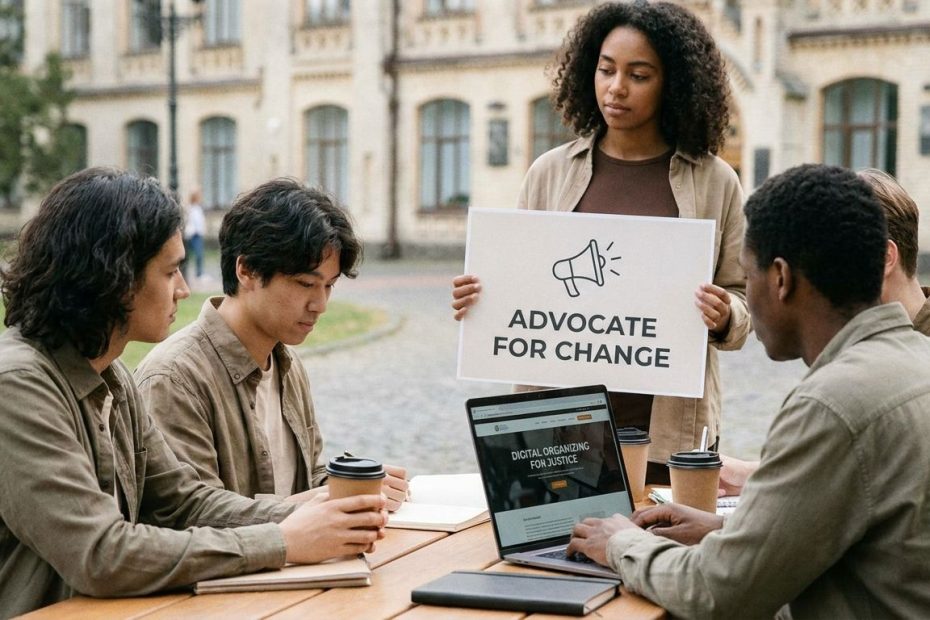
Student Activism 2.0 is Generation Z (Gen Z) campus organizing that blends social media, petitions, digital fundraising, public meetings, rallies, boycotts, and policy pressure to address social justice issues on campus.
Gen Z student activism isn’t limited to viral posts, and it isn’t limited to protests on the quad. You’re looking at a hybrid form of civic engagement shaped by affordability stress, climate concern, campus speech debates, institutional trust, and the speed of digital organizing. This article explains what students are doing, why it matters, where the risks show up, and what colleges can learn from the way this generation organizes.
What Does Student Activism 2.0 Mean?
Student Activism 2.0 means campus advocacy that moves between digital platforms and real-world pressure. Students use online tools to spread a message quickly, then connect that attention to petitions, meetings, protests, volunteering, boycotts, and demands for campus policy change.
Older student movements relied on flyers, meetings, marches, sit-ins, student newspapers, and face-to-face organizing. Gen Z still uses those tools, but you’ll see them paired with group chats, social media posts, online fundraising, digital petitions, shared documents, live updates, and rapid-response messaging. A campaign can move from a dorm conversation to a campus-wide action list in hours. That speed changes how students build coalitions, pressure administrators, and keep attention on an issue.
The United Way Gen Z Activism Survey found that most Gen Z activism reported in its sample happened digitally, but a meaningful share still took place in person. That matters because it pushes back on the idea that online activism is automatically shallow. Digital action can spread awareness, but the stronger campaigns usually connect online visibility to organized offline work. When you evaluate Gen Z student activism, look for that link between attention and action.
Which Social Justice Issues Are Driving Gen Z Student Activism?
Gen Z campus activism is driven by affordability, healthcare access, housing, climate, safety, income inequality, racial equity, education costs, and free expression. The biggest surprise for many readers is how much economic pressure shapes today’s social justice on campus.
United Way’s survey ranked inflation and cost of living, healthcare access and affordability, and affordable housing as top Gen Z concerns. Climate initiatives, gun policy, income inequality, racial equity, and education access also ranked strongly. That mix tells you something useful: students are not organizing only around symbolic issues. Many campaigns connect directly to rent, tuition, food insecurity, medical costs, public safety, and whether students can stay enrolled without constant financial strain.
Harvard’s youth polling adds another layer. Many young adults reported limited financial safety, and inflation ranked as a top economic priority. For college students, that pressure can show up in demands around tuition, fees, wages for student workers, housing support, emergency aid, food access, and transparency in campus spending. When a campus campaign sounds political, it often has a practical student-life issue underneath it.
How Does Social Media Turn Campus Concern Into Action?
Social media helps students turn concern into action by making issues visible, recruiting supporters, coordinating logistics, and keeping pressure on decision-makers. It works best when posts point people toward a clear next step.
Pew Research Center found that users across major platforms see political material more often than they post it, with X users especially likely to use the platform to follow politics or political issues. TikTok, Instagram, Facebook, and X each serve a different role in campus organizing. TikTok can package a message in a short video, Instagram can circulate graphics and event details, X can track real-time debate, and private chats can coordinate turnout. Students don’t need a formal office to start building momentum.
Research on student leaders and social media found that students use platforms to build awareness, develop their public voice, respond to different organizing needs, and gauge social opinion. The same research also warned against treating digital work as enough by itself. A post can open the door, but durable organizing still needs people who can write demands, book rooms, manage turnout, meet with officials, build coalitions, and follow through after attention fades.
Are Students Actually Participating Offline?
Yes, many students participate offline, but participation varies by issue, campus, time, and personal risk tolerance. Offline activism includes volunteering, public meetings, rallies, protests, petitions, boycotts, contacting officials, and student government advocacy.
PRRI reported that Gen Z adults volunteered, attended rallies, avoided brands to send a message, contacted elected officials, and attended community meetings during the prior year. Knight Foundation and Ipsos also found measurable participation among enrolled college students in protests, public meetings, contacting elected officials, and donations to causes or campaigns. United Way’s survey reported that more than half of Gen Z respondents in higher education had participated in rallies or protests. Taken together, these findings show that Gen Z student activism reaches beyond posting.
Still, not every student wants to march, risk discipline, or put their name on a public campaign. Some students sign petitions, share resources, volunteer quietly, attend meetings, donate small amounts, help with research, or work through student organizations. Others take no action on a given issue because they disagree, feel unsure, lack time, fear backlash, or don’t trust the campaign’s strategy. A healthy reading of the data leaves room for activism, caution, disagreement, and silence on the same campus.
Why Do Campus Protests Feel Larger Than The Numbers?
Campus protests feel larger than the numbers because visible protests cluster at certain institutions and spread quickly through media coverage. A protest at a large, urban, or selective campus can shape national attention, even when most colleges are not seeing frequent demonstrations.
The ACUI-sponsored report on student activism and campus protests found that a minority of four-year colleges and universities in its dataset had any demonstration activity during the studied academic year. A much smaller share had frequent protest activity. Large institutions and urban institutions were more likely to report protest activity, and very selective colleges saw higher rates of repeated protest. That pattern helps explain why the public may perceive campus protest as everywhere.
Visibility also changes the way activism is judged. A small petition drive may affect a campus policy but never appear in national coverage. A tense protest with an encampment, building occupation, arrest, or administrative response can become a headline within minutes. You get a distorted view if you judge all Gen Z student activism by the most visible confrontations alone. Most campus advocacy is less dramatic: meetings, letters, coalition work, teach-ins, budget requests, volunteer work, and policy proposals.
Why Are Free Expression And Campus Safety So Tense?
Free expression and campus safety are tense because students often support unpopular speech and also worry that some speech can harm community members. That creates hard decisions for campuses when activism, protest, invited speakers, and counter-protest collide.
Knight Foundation and Ipsos found strong student support for allowing unpopular opinions, along with concern that some forms of speech can be as damaging as physical violence. Those two findings sit side by side. Students may defend open debate in principle and still ask administrators to respond when speech feels threatening, humiliating, or targeted. That tension is one reason campus activism can become controversial so quickly.
Students also respond differently when they oppose a campus speaker. Some would take no action, some would boycott, some would attend and listen, some would counter-protest, and a smaller share would try to stop or disrupt the event. Those differences matter. A campus where students disagree about tactics needs rules that protect speech, keep access to education open, and set limits on conduct without favoring one viewpoint over another.
How Do Campus Protest Rules Affect Student Activism?
Campus protest rules affect student activism by shaping where, when, and how students can organize without facing disciplinary consequences. Confusion about those rules can turn a planned action into a conduct problem.
Foundation for Individual Rights and Expression and College Pulse data found that many students were not very aware, or not aware at all, of their college’s written protest policies. Students who had some awareness were more likely to believe that petitions, signs, and flyers were allowed. They were far less likely to believe encampments or building occupations were allowed. That gap matters because students often choose tactics before they fully understand the policy risks.
Clear rules help students plan stronger actions. If you’re organizing, you need to know permit rules, space reservation rules, sound limits, building access rules, overnight policies, anti-disruption standards, and possible conduct consequences. If you’re a college leader, vague rules invite conflict because students can read them as selective enforcement. The better path is consistent, visible, viewpoint-neutral policy communication before a protest begins.
What Can Universities Learn From Gen Z Student Activism?
Universities can learn that activism is often a form of civic learning, not just disruption. Students are studying power, budgets, institutional rules, public messaging, coalition-building, and the limits of formal decision-making in real time.
Academic research on campus activism describes student organizing as a learning activity where students navigate institutional norms, risk, power, and campus infrastructure. That doesn’t mean every tactic is effective or every demand should be accepted. It does mean colleges lose an educational opportunity when they treat every protest as a public relations problem. Students learn more when institutions create real channels for feedback, explain decisions, and respond with consistency.
Universities can also reduce conflict by building better pathways before a crisis arrives. Useful steps include publishing plain-language protest policies, training student leaders on rights and responsibilities, creating regular listening sessions, supporting student government processes, and giving faculty clear guidance for dialogue in class. Trust matters here. Knight Foundation and Ipsos found that students trusted faculty and administrators more than government or social media companies, which gives colleges a chance to lead with clarity rather than silence.
Where Is Campus Activism Heading?
Campus activism is heading toward faster, issue-driven, hybrid campaigns that combine digital reach with organized pressure on institutions. Gen Z students are likely to keep using social media as a launchpad, but offline credibility will still decide whether campaigns last.
The future of Student Activism 2.0 will be shaped by affordability, trust, safety, climate concern, and free expression debates. Gen Z students are entering campus life at a time when many young adults feel financially squeezed and skeptical of major institutions. That pressure makes campus issues feel connected to wider public problems. A tuition debate can become an affordability campaign, and a campus safety debate can become a broader argument about rights, belonging, and institutional accountability.
The strongest student movements will be the ones that manage continuity. Graduation turnover, burnout, internal disagreement, and academic pressure can weaken a campaign even when the cause has support. Students who document goals, train new leaders, choose tactics carefully, and connect online attention to practical demands will have a better chance of getting heard. For colleges, the message is plain: treat Gen Z student activism as a signal, not just a disruption.
How Is Gen Z Changing Student Activism On College Campuses?
- Gen Z blends digital organizing with campus action.
- Students use posts, petitions, fundraising, meetings, rallies, boycotts, and policy demands.
- Top issues include affordability, climate, safety, equity, and speech.
What Student Activism 2.0 Really Shows
Student Activism 2.0 shows that Gen Z is neither apathetic nor only online. You’re seeing students use digital tools to move faster, but the work that lasts still depends on organizing skill, clear demands, coalition trust, and a realistic read of campus rules. The most useful way to understand social justice on campus is to look past the loudest moments and examine the full range of activity: volunteering, petitions, meetings, boycotts, teach-ins, rallies, and policy advocacy. For students, the practical lesson is to connect visibility with strategy. For colleges, the lesson is to respond with clear rules, genuine dialogue, and enough respect to treat activism as part of civic education.
References
- United Way of the National Capital Area — The Gen Z Activism Survey
- PRRI — A Political and Cultural Glimpse Into America’s Future: Generation Z’s Views on Generational Change
- Harvard Institute of Politics — Harvard Youth Poll
- ACUI and Constructive Dialogue Institute — Student Activism and Campus Protests
- Ipsos — College Student Views On Free Expression And Campus Speech
- Knight Foundation and Ipsos — College Student Views On Free Expression And Campus Speech
- College Pulse — Student Encampment Protests
- Foundation for Individual Rights and Expression — Student Encampment Protests
- Foundation for Individual Rights and Expression and College Pulse — Student Policy Awareness Topline
- Pew Research Center — How Americans Navigate Politics On TikTok, X, Facebook And Instagram
- Journal of Student Affairs Inquiry, Improvement, and Impact — #Activism: Understanding How Student Leaders Utilize Social Media For Social Or Political Change
- Gallup — Water Is A Common Concern In Gen Z’s Climate Outlook
- Acta Psychologica — What Is At Risk In Campus Activism?
- Harvard Graduate School of Education — The New Age Of Student Activism
- National Center for Education Statistics — Report On The Condition Of Education

Nirdosh Jagota is Managing Partner at GRQ Biotech Advisors with 30+ years in the biotech industry. A former executive at Amgen, Genentech/Roche, Merck, and Pfizer, he has led >25 NDAs/BLAs/MAAs and hundreds of INDs across global regulatory, quality, and compliance.