
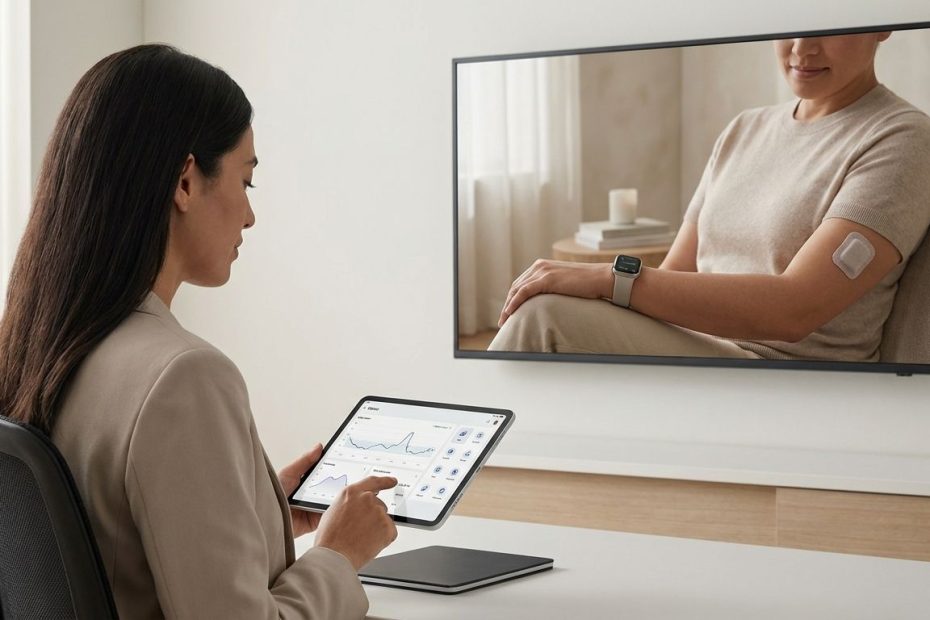
Wearable biosensors are turning remote patient monitoring into a more precise, more continuous, and more usable model of care. When you choose the right sensor for the right condition, you can track changes earlier, reduce missed warning signs, and give clinicians data they can actually use.
You are no longer limited to occasional office readings or disconnected home devices. The strongest wearable biosensors now support glucose tracking, cardiac rhythm monitoring, oxygen saturation review, blood pressure programs, and multi-parameter surveillance in the home. This article breaks down the seven device categories and platforms pushing remote patient monitoring forward, what makes each one useful, and where the limits still matter.
1. Dexcom G7 And Dexcom G7 15 Day
If you manage diabetes care, metabolic monitoring, or broader remote physiologic monitoring workflows, continuous glucose monitoring remains one of the clearest success stories in wearable biosensing. Dexcom G7 and Dexcom G7 15 Day sit near the top of the market because they deliver ongoing glucose trend data rather than isolated readings. That difference matters when you need to detect patterns, respond to excursions, and review patient status without waiting for the next office visit.
From an operational standpoint, these sensors fit naturally into remote patient monitoring because the data stream is continuous, actionable, and familiar to clinicians. You can use trend visibility to support medication review, meal-related pattern detection, and coaching around time in range. For patients, the value is just as practical: fewer blind spots, fewer surprises, and a much better sense of what is happening between appointments.
The stronger case for Dexcom in remote care is not novelty. It is repeatable data capture, a mature software ecosystem, and a clinical workflow that many care teams already understand. When you evaluate wearable biosensors by whether the signal changes management, continuous glucose monitoring remains one of the most useful categories available.
You also need to keep usability in view. Adhesive tolerance, sensor wear comfort, app dependence, and alert settings can shape long-term adherence. A sensor only helps when a patient keeps wearing it, the signal remains stable, and the care team knows what to do with the incoming information.
2. Dexcom Stelo Over-The-Counter Continuous Glucose Monitor
Dexcom Stelo deserves its own place on this list because it expands the reach of continuous glucose monitoring beyond traditional prescription-only pathways. That changes the remote monitoring conversation in a meaningful way. You get a wearable biosensor designed to increase access, which opens the door for broader metabolic awareness and earlier tracking for adults who want structured glucose feedback.
For remote patient monitoring, the relevance goes beyond convenience. Over-the-counter access can reduce friction in the adoption process and support programs that need lower barriers to entry. If you work in employer health, virtual care, prevention-focused care delivery, or cash-pay monitoring models, that kind of accessibility can change program design.
Stelo also reflects a larger market shift: wearable biosensors are moving from narrow specialty use toward wider participation in preventive and condition-adjacent monitoring. That does not mean every user needs continuous glucose monitoring. It means the category now has a more direct route into everyday care models where remote tracking and behavior-based intervention are becoming more common.
You still need disciplined device selection. Over-the-counter does not mean casual, and it does not erase the need for patient education. Users need to understand what the readings mean, how to respond, and when clinical escalation is appropriate.
3. Abbott FreeStyle Libre 3 And FreeStyle Libre 3 Plus
Abbott FreeStyle Libre 3 and FreeStyle Libre 3 Plus remain major players in wearable biosensors for remote patient monitoring. If your focus is diabetes management, chronic care coordination, or population health at scale, these systems matter because they have broad recognition, real-world clinical use, and a monitoring model centered on continuous data rather than occasional checks.
The reason Libre remains important is straightforward. You can integrate glucose trends into remote review, identify recurring highs and lows, and support medication adjustment or lifestyle coaching with much more precision than fingerstick-only routines. That gives care teams a better shot at identifying deterioration early and helps patients connect daily choices with measurable outcomes.
You also need balanced evaluation. Safety notices and device recalls are part of the wearable medical device market, and they matter when you are selecting tools for remote monitoring programs. A top device is not a perfect device. It is a device with a meaningful clinical role, strong adoption, and a risk profile you understand and manage directly.
Libre also highlights a larger reality in remote patient monitoring: scale can amplify both value and operational complexity. You gain continuous data and stronger visibility, yet you also take on alert management, replacement logistics, support demands, and patient onboarding requirements. That tradeoff is worth managing when the clinical upside is strong.
4. iRhythm Zio Cardiac Monitor And Zio Patch
Cardiac rhythm monitoring is one of the strongest use cases for wearable biosensors, and the iRhythm Zio family stands out because it targets a real clinical need with practical long-wear monitoring. If you are trying to detect intermittent arrhythmias, occasional office electrocardiograms often miss the event window. A wearable electrocardiogram patch changes that by extending observation across normal daily life.
The value for remote patient monitoring is direct. You can capture symptomatic and asymptomatic rhythm events over a longer period, improve the odds of identifying irregular patterns, and reduce the dependence on short in-clinic snapshots. For patients dealing with palpitations, dizziness, unexplained episodes, or suspected rhythm issues, that longer monitoring window can be the difference between guessing and documenting.
Zio also fits the broader shift toward low-burden medical wearables. A patch is less disruptive than many traditional monitoring setups, and that matters for adherence. When you ask patients to wear something for days rather than minutes, comfort, simplicity, and uninterrupted use become operational factors, not just product details.
You should also separate this category from general wellness wearables. A consumer smartwatch can flag rhythm-related concerns in limited cases, yet a medical-grade patch built for extended electrocardiogram capture serves a different purpose. In remote patient monitoring, that distinction shapes diagnostic confidence and determines how useful the data will be when clinical decisions are on the line.
5. Biobeat BB-613-BPM
Biobeat BB-613-BPM earns attention because it represents the multi-parameter direction that remote patient monitoring is moving toward. Instead of tracking a single signal, it is designed to monitor several vital signs through a wearable format. That matters when you need a richer view of patient status outside the hospital.
Multi-parameter monitoring can improve remote care by giving you more than one warning sign at a time. Changes in blood pressure, pulse rate, and other physiologic signals can create a more useful picture of deterioration risk than a single isolated reading. If you manage post-discharge patients, complex chronic disease, or hospital-at-home workflows, that added visibility can support earlier intervention.
The appeal of Biobeat is not just technical ambition. It is the effort to make continuous vital sign monitoring more mobile and less dependent on conventional bedside equipment. That supports a care model where patients remain at home while clinicians still review meaningful physiologic data with reasonable frequency.
You do need disciplined expectations in the blood pressure category. Wearable blood pressure monitoring is one of the most watched areas in digital health, yet it is also one of the most scrutinized. Performance, calibration logic, use conditions, and intended use matter a great deal. If your program needs blood pressure data for treatment decisions, validation standards should sit near the top of your purchasing checklist.
6. Empatica EmbracePlus Health Monitoring Platform
Empatica EmbracePlus stands out because it reflects where advanced wearable biosensors are heading: multi-signal sensing tied to a monitoring platform rather than a disconnected gadget. If you are evaluating remote monitoring tools for clinical programs, research environments, or higher-acuity home observation, this type of platform deserves attention.
The strength of a platform model is integration. Instead of collecting one isolated measure, you can combine physiologic signals, trend them over time, and route them into a broader care workflow. That creates more value for teams that need ongoing review, threshold-based alerts, and structured escalation rather than passive data collection.
Empatica also shows how wearables are maturing inside formal medical pathways. Advanced sensing is no longer limited to experimental concepts or niche pilot programs. You now have devices and platforms designed to support remote physiologic monitoring with clearer regulatory footing and stronger implementation potential.
For providers and program leaders, the important question is not whether a multi-signal wearable sounds impressive. The better question is whether the signal set matches the condition being monitored and whether the incoming data will lead to timely action. If the workflow cannot absorb the information, even a strong biosensor platform can become noise.
7. Current Health Wearable Platform
Current Health belongs on this list because remote patient monitoring is increasingly defined by connected care ecosystems, not just standalone sensors. If your goal is to monitor patients at home across several vital signs and integrate that data into care delivery, a platform-based wearable becomes far more relevant than a single-purpose tracker.
This category matters in hospital-at-home programs, post-acute care, chronic disease management, and escalation-sensitive patient populations. You can use connected wearables to observe pulse rate, temperature, oxygen saturation, movement, and other indicators in a way that supports active surveillance outside a facility. That creates practical value when you need to identify worsening status before it turns into an emergency department visit or readmission.
Current Health also reflects an important market truth: the future winners in remote patient monitoring are likely to be the tools that combine sensing, connectivity, clinical review, and response workflows in one operational model. Data without routing, triage, or escalation loses value quickly. Platform-based systems address that problem more directly than isolated consumer wearables.
You should still evaluate the basics with care. Connectivity reliability, battery performance, patient comfort, onboarding demands, integration with the electronic health record, and alert burden all shape program success. A wearable platform can support excellent remote monitoring, but only when the operational design is as strong as the sensor itself.
What Makes These Wearable Biosensors So Important For Remote Patient Monitoring?
These seven entries matter because remote patient monitoring only works when the data is clinically relevant, repeatable, and usable at scale. Wearable biosensors solve a long-standing care gap by moving measurement into daily life. That gives you trend data between office visits, better visibility into treatment response, and earlier awareness of deterioration.
You can also see a clear pattern across the leading categories. The strongest wearables focus on signals that clinicians already know how to interpret: glucose, electrocardiogram rhythms, oxygen saturation, blood pressure, pulse rate, temperature, and activity-linked physiologic changes. That makes adoption easier and increases the chance that the data will support decisions rather than create confusion.
Another reason these wearables matter is patient convenience. If a sensor is easy to wear, simple to replace, and connected to a usable app or platform, adherence tends to improve. Remote monitoring breaks down fast when devices are uncomfortable, difficult to sync, or hard to understand.
This is also where medical wearables separate themselves from general consumer health gadgets. A true remote patient monitoring device needs a defined clinical role, a signal that matters, and a workflow that supports review and response. The top biosensors on this list meet that standard more convincingly than generic wellness trackers.
Where Wearable Biosensors Still Fall Short
You should stay realistic about the limits. Wearable biosensors can improve monitoring, yet they do not remove the common friction points that shape outcomes in real programs. Adhesive reactions, skin irritation, battery life, data gaps, Bluetooth disconnections, patient fatigue, and alert overload remain practical issues that can reduce device value over time.
Accuracy also varies by category. Continuous glucose monitors and electrocardiogram patches have stronger established use cases in remote care. Cuffless blood pressure wearables remain promising, but they still require careful scrutiny before you rely on them for diagnosis or treatment decisions. If your clinical model depends on precise blood pressure management, a validated cuff-based path may still be the safer operational choice.
You also need to watch for market noise. Unauthorized blood pressure devices, misleading ads, and fake noninvasive glucose claims continue to confuse buyers. In remote patient monitoring, poor device selection creates more than inconvenience. It can distort readings, undermine trust, and delay proper care escalation.
The operational lesson is simple: choose wearable biosensors the same way you would choose any medical technology. Verify intended use, check regulatory status, confirm workflow fit, and evaluate what happens when the readings change. The best remote monitoring programs are built on disciplined selection, not gadget enthusiasm.
How You Should Choose The Right Wearable Biosensor
Start with the signal you need to monitor, not the brand you recognize. If the patient need is glucose management, a continuous glucose monitor makes sense. If the issue is intermittent arrhythmia detection, an electrocardiogram patch is the better fit. If the care plan depends on several vital signs at once, a multi-parameter wearable platform will likely offer more value.
You should also ask what action the care team will take when the data changes. A wearable biosensor only strengthens remote patient monitoring when the readings connect to a workflow. That may include medication review, outreach from a nurse, pharmacist follow-up, escalation to a physician, or referral for urgent evaluation.
Patient experience should stay near the center of your evaluation. Comfort, wear time, app usability, charging or replacement burden, alert clarity, and connectivity all affect adherence. A clinically strong device can still fail in practice if patients dislike wearing it or cannot keep it running consistently.
From a program leadership standpoint, integration matters just as much as sensor quality. You need a wearable that fits billing models, data review processes, staffing capacity, and documentation requirements. The right biosensor is the one that aligns clinical need, patient tolerance, and operational execution.
Which Wearable Biosensors Are Best For Remote Patient Monitoring?
- Best for glucose: Dexcom G7, Dexcom Stelo, Abbott FreeStyle Libre 3
- Best for cardiac rhythm: iRhythm Zio Patch
- Best for multi-parameter monitoring: Biobeat, Empatica EmbracePlus, Current Health
- Best choice depends on: condition, signal quality, comfort, workflow fit
Choose Devices That Drive Action, Not Just Data
The top wearable biosensors advancing remote patient monitoring are the ones that deliver useful signals, support steady adherence, and fit real clinical workflows. If you focus on condition-specific value, the leaders become clear: continuous glucose monitors for diabetes, electrocardiogram patches for rhythm tracking, and multi-parameter wearables for broader home surveillance. You also need to stay selective, especially in blood pressure monitoring and in any category crowded with unverified claims. When you match the right biosensor to the right patient need, remote monitoring becomes more than passive tracking; it becomes a practical tool for earlier intervention, stronger follow-up, and better care delivery outside the clinic.
References
- https://www.fda.gov/medical-devices/digital-health-center-excellence/medical-devices-incorporate-sensor-based-digital-health-technology
- https://www.fda.gov/news-events/press-announcements/fda-clears-first-over-counter-continuous-glucose-monitor
- https://www.fda.gov/medical-devices/medical-device-recalls-and-early-alerts/glucose-monitor-sensor-recall-abbott-diabetes-care-removes-certain-freestyle-libre-3-and-freestyle
- https://www.accessdata.fda.gov/cdrh_docs/pdf16/K163512.pdf
- https://www.accessdata.fda.gov/cdrh_docs/pdf24/K241066.pdf
- https://www.accessdata.fda.gov/cdrh_docs/pdf24/K242737.pdf
- https://newsroom.heart.org/news/cuffless-blood-pressure-technologies-in-wearable-devices-show-promise-to-transform-care
- https://newsroom.heart.org/news/remote-monitoring-and-pharmacist-helped-improve-hard-to-control-blood-pressure
- https://www.cdc.gov/diabetes/php/data-research/data-statistics/index.html
- https://www.medicalstartups.org/top/biosensor/

Nirdosh Jagota is Managing Partner at GRQ Biotech Advisors with 30+ years in the biotech industry. A former executive at Amgen, Genentech/Roche, Merck, and Pfizer, he has led >25 NDAs/BLAs/MAAs and hundreds of INDs across global regulatory, quality, and compliance.