
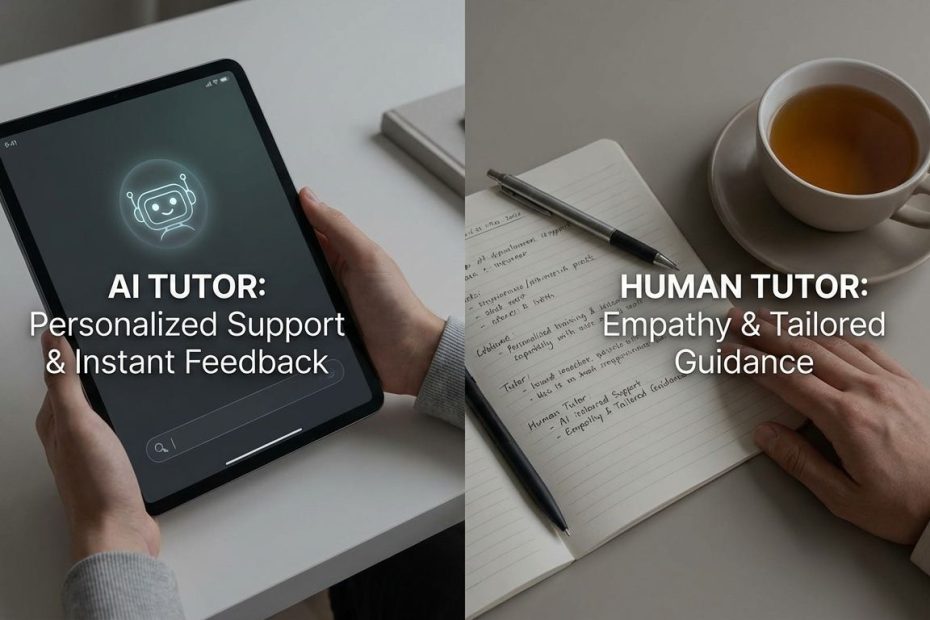
No, chatbots are unlikely to replace human tutors outright. You are far more likely to see artificial intelligence handle routine explanation, practice, and on-demand homework help, while human tutors stay essential for motivation, judgment, accountability, and truly personalized teaching.
If you are deciding how artificial intelligence fits into learning, tutoring, or education strategy, the real issue is not whether chatbots can answer questions. It is whether they can teach well enough, consistently enough, and safely enough to displace the human role that families, schools, and students still value. This article gives you a practical read on where artificial intelligence tutoring is already winning, where human tutors still hold the advantage, and what the tutoring market is likely to look like as these tools mature.
Can AI Tutors Really Replace Human Tutors?
You should start with the most honest answer: artificial intelligence tutors can replace some tutoring tasks, but they do not replace the full job of a skilled human tutor. A chatbot can explain algebra steps at midnight, generate fresh practice questions in seconds, and keep going without scheduling, travel, or hourly billing. That makes it useful right away for students who need immediate support and for families that want lower-cost academic help.
Yet tutoring has never been just content delivery. When you pay for a strong tutor, you are not only buying explanations. You are buying diagnosis, pacing, encouragement, pressure to stay on track, and the ability to tell whether a student is confused, guessing, tired, embarrassed, or simply disengaged. Current chatbots simulate some of that through prompts and follow-up questions, but they still operate through patterns in text, voice, or uploaded material. They do not truly observe the student in the same way a human does.
You can also see the limits in how leading artificial intelligence education products present themselves. The strongest products are not marketed as total teacher replacements. They are framed as study support, guided practice, and step-by-step help. That positioning matters. When the companies building the tools design them to coach, scaffold, and support rather than replace the human educator, it signals where the market has actually landed.
The practical takeaway is straightforward. If your goal is lower-cost access to explanations, repetition, and instant feedback, artificial intelligence already delivers real value. If your goal is sustained improvement for a student who needs trust, structure, and diagnosis beyond the worksheet, the human tutor remains hard to dislodge. Replacement is happening at the task level more than the relationship level.
That distinction is what most coverage misses. A family may stop paying a tutor for basic homework help and move that work to ChatGPT or another tutor bot. That same family may still hire a human for exam prep, weekly accountability, writing feedback, learning gaps, or confidence rebuilding. When you separate tutoring into tasks rather than treating it as one single service, the market shift becomes much easier to understand.
Are Students Already Replacing Tutors With Chatbots?
Yes, some students already are, and the shift is no longer theoretical. Survey data has shown that a notable share of students and parents report using ChatGPT in place of traditional tutoring sessions. That does not prove chatbot tutoring is better in every setting, but it does prove substitution is already happening in the real market.
The reason is not hard to identify. Cost, convenience, and speed create a powerful advantage. A student can open a chatbot, paste a question, ask for a simpler explanation, request more examples, and repeat the cycle without worrying about scheduling, transportation, cancellation fees, or minimum session lengths. If you compare that to hiring a private tutor for repeated short questions across a week, the difference in convenience is hard to ignore.
You also need to pay attention to what families often mean when they say a chatbot is “more effective.” In many cases, they do not mean the model teaches with better pedagogy than a top tutor. They mean it is available when needed, responds instantly, and costs far less. That combination can feel more effective because the student uses it more often. Access changes usage, and usage changes perception.
The market is not collapsing into full automation, though. What appears to be happening is a split. Lower-touch tutoring, quick homework help, and repetitive drill work are more exposed to chatbot substitution. Premium tutoring built around test strategy, writing improvement, subject mastery, and student management remains more durable. If you work in education, this is where strategy matters. The routine end of tutoring is becoming software-assisted at speed.
You should also expect the substitution pattern to vary by subject. Mathematics, vocabulary practice, basic science review, language drills, and structured homework support are easier for artificial intelligence to handle. Open-ended writing, complex reading interpretation, executive function support, and students with inconsistent motivation still lean more heavily toward human guidance. Chatbot adoption is real, but it is uneven, and that unevenness is where many tutoring businesses will either adapt or lose ground.
Do AI Tutors Actually Improve Learning Outcomes?
The answer here is more disciplined than the marketing claims you often hear. Artificial intelligence tutors can improve learning outcomes in some situations, especially when they use guided teaching methods or when they support a human tutor rather than operate alone. The strongest evidence so far points to human and artificial intelligence working together better than chatbot-only replacement.
That matters because teaching is not the same as answering. A system can solve the problem correctly and still fail as a tutor. Good tutoring requires pacing, questioning, error diagnosis, and knowing when to hold back the answer so the student can do the thinking. This is where many general-purpose chatbots still show uneven performance. They can explain well one moment and then become too eager, too vague, or too solution-driven the next.
Research on tutor support tools has been especially important because it tests a more practical model. Instead of asking whether a chatbot should replace the tutor, it asks whether a tutor becomes better with artificial intelligence support. That model has shown encouraging results, especially for less experienced tutors who benefit from prompts, suggested explanations, and improved instructional moves during live sessions.
If you are responsible for academic outcomes, this should change the way you frame the decision. The question is not whether artificial intelligence can stand alone in every tutoring situation. The better question is whether it can raise the floor of tutoring quality at scale. When artificial intelligence helps average tutors become more consistent, helps students get help between sessions, and reinforces good instructional practices, the gains become more realistic and more measurable.
You should also resist broad claims that chatbot tutoring has already solved education. Evaluation research still shows inconsistency in pedagogical quality across large language model systems. A model may answer accurately in one domain and still fail to sequence instruction properly, surface misconceptions, or calibrate difficulty to the learner’s level. Learning gains depend on more than access to explanations. They depend on how those explanations are delivered, when they are delivered, and what the student does afterward.
That is why guided study modes, tutoring-specific prompts, and structured educational products matter more than raw model power. If you want better outcomes, the winning formula is not just a smarter model. It is a better teaching design built around retrieval practice, step-by-step guidance, active questioning, and enough friction to keep the student thinking instead of copying. Artificial intelligence can support that. It does not guarantee it.
What Can AI Tutors Do Better Than Human Tutors?
If you look at tutoring through an operational lens, artificial intelligence already outperforms humans in several areas. It is available at any hour, scales instantly, responds fast, adapts explanations on demand, and handles repetition without fatigue. Those are not minor features. They are major economic and usability advantages that change how students seek help.
You can see the edge most clearly in low-friction academic support. A student can ask for a simpler explanation, then a harder version, then a quiz, then a hint rather than the full answer, then a practice set based on the same weakness. A human tutor can do all of that too, but not with the same speed, cost structure, or around-the-clock availability. Artificial intelligence compresses the wait time between confusion and support.
Personalization at scale is another major strength. A chatbot can switch reading level, tone, subject depth, and format within seconds. It can move from bullet points to worked examples to a short quiz to a study guide in one session. For students who learn through repetition and rephrasing, that flexibility matters. Many do not need a new expert every time they get stuck. They need the same idea explained five different ways until one version clicks.
You also get an efficiency gain in content generation. Artificial intelligence can build worksheets, flashcards, mini-assessments, summaries, vocabulary drills, essay outlines, and revision prompts with very little delay. That means students can spend more time practicing and less time waiting for materials. It also means tutors and teachers can use the tool behind the scenes to reduce prep work and increase instructional time.
Cost pressure is the force pushing this category forward. A subscription-style artificial intelligence tutor or chatbot assistant can be far cheaper than repeated private sessions. For households balancing budget and academic support, that price difference is enough to change behavior. You should expect artificial intelligence adoption to keep rising wherever families view tutoring as a utility service rather than a premium relationship-based service.
There is also a persistence advantage. Human tutors work on schedules. Students do not struggle on schedules. They hit friction during homework, revision, and late-night test preparation. Artificial intelligence sits inside those moments. That puts it closer to the actual learning process. If a tool is present at the point of struggle, it shapes behavior in ways that traditional tutoring often cannot.
Where Do Human Tutors Still Clearly Outperform Chatbots?
Human tutors still hold the advantage in the parts of tutoring that require judgment, trust, and emotional reading. If you have ever watched a skilled tutor work with a frustrated student, you know that much of the job is not about the worksheet itself. It is about sensing resistance, identifying avoidance, deciding when to push, and rebuilding confidence without lowering standards.
A chatbot can ask, “Do you want a hint?” A human tutor can tell that the student is pretending to understand to avoid embarrassment. A chatbot can offer encouragement. A human tutor can recognize that the student is overwhelmed because three weak fundamentals are colliding at once. That kind of diagnosis often determines whether learning actually moves forward. It is one of the biggest reasons the best tutors continue to command strong demand.
Accountability is another category where people still beat software. Students often need a real appointment, a real person, and a real expectation of preparation. Artificial intelligence is easy to open and easy to close. That convenience helps access, but it also reduces commitment. A tutor creates rhythm. The student prepares because someone will notice if the work is not done. That pressure is not always pleasant, but it is often productive.
You should also think about complex academic work. Strong tutoring in writing, deep reading, advanced problem solving, and exam preparation often requires strategic judgment that goes beyond the immediate question. A tutor sees patterns across weeks of work. The tutor notices recurring weaknesses, not just the error inside one prompt. That continuity matters when the goal is long-term growth rather than a quick answer.
Students with motivation issues, attention challenges, learning differences, or inconsistent study habits often benefit the most from human involvement. These learners do not only need explanation. They need pacing, repetition, reframing, and someone who can decide when to change course. Artificial intelligence can support that process, but it still struggles when the real barrier is not the content itself but the student’s relationship to the content.
The strongest human tutors also provide something software does not create easily: trust that compounds over time. When a student feels known, the tutor can challenge more directly, correct more efficiently, and push more productively. That relational equity is one reason human tutoring remains durable at the higher end of the market. Families are not just paying for answers. They are paying for progress that depends on consistency, observation, and rapport.
Are AI Tutors Safe, Accurate, And Trustworthy For Kids And Teens?
You should treat artificial intelligence tutors as useful tools, not as fully trusted authorities. They can be effective for practice and explanation, but accuracy problems, weak pedagogy, privacy concerns, and overreliance remain serious issues, especially for younger users. If a family or school treats the chatbot as self-validating, mistakes become harder to catch.
Accuracy is the first concern. Large language models can produce confident responses that sound polished and still contain factual errors, flawed reasoning, or misleading steps. In tutoring, that risk is not minor. A wrong explanation can teach the misconception rather than fix it. If the student lacks enough prior knowledge to spot the error, the system’s fluency can become part of the problem.
Trustworthiness also depends on design. A tutoring tool built to guide the learner, ask questions, and slow down answer delivery is different from a general chatbot that defaults to producing the fastest plausible response. Educational quality comes from restraint as much as capability. If the system gives away too much too quickly, students may finish assignments faster and learn less.
Privacy and disclosure matter too. Many students freely paste homework, personal reflections, essays, and school information into chatbots without thinking about where that data goes or how long it is retained. Younger users are especially likely to treat a conversational system as more private than it really is. Families and schools need clear rules around data handling, appropriate use, and what should never be shared with an external tool.
You should also account for reliance. When students use artificial intelligence for every difficult moment, they may reduce productive struggle. That weakens memory formation and independent problem solving. The tool feels helpful because it lowers friction, but lower friction does not always produce stronger learning. Good tutoring often requires the student to work before getting the next clue. Artificial intelligence products vary widely in whether they preserve that discipline.
For younger learners, supervision remains the safer model. The better setup is usually human-in-the-loop use, where a parent, teacher, or tutor helps verify accuracy, set boundaries, and decide when the chatbot is helping learning versus simply shortening the path to completion. If you want safe use, you need rules, review, and product choices that favor guided study over answer dumping.
What Will The Tutoring Market Look Like As Artificial Intelligence Gets Better?
You should expect a split market rather than a winner-take-all outcome. Routine tutoring will move toward software-assisted delivery, lower prices, and faster response. High-value tutoring will move further toward mentorship, specialized instruction, executive support, exam strategy, and premium personalization. The middle of the market is where the most pressure will build.
This is how many service categories change when software enters them. Tasks that are repetitive, structured, and easy to standardize get compressed first. In tutoring, that includes drill work, basic explanations, low-stakes homework help, and standard practice generation. If your offering depends on those services alone, artificial intelligence puts pressure on price, retention, and perceived differentiation.
The stronger human tutors will not disappear. They will become more selective about where they add value. You are likely to see more tutors position themselves around outcomes that software cannot easily replicate: confidence rebuilding, test pacing, writing quality, subject diagnosis, weekly accountability, and parent communication. Tutors who use artificial intelligence well may also outperform tutors who ignore it, because they can deliver more support between meetings and prepare better materials in less time.
Education companies are likely to blend the two models. You can already see signs of a hybrid structure where artificial intelligence handles instant assistance and humans step in for checkpoints, deeper intervention, and progress review. That reduces labor intensity without removing human oversight. For many organizations, that may become the operating model that balances scale with trust.
You should also watch what happens to expectations. Once students get used to instant support, they will expect faster response times from everyone. Human tutors may need to redesign communication, follow-up, and homework support to stay competitive. The service standard is changing. Artificial intelligence is not just another tool in the market. It is reshaping what “responsive tutoring” means.
The long-term winners will probably be the providers who know exactly what part of learning they own. If you are a tutor, school, or education platform, vague positioning will struggle. You need to define whether you provide speed, mastery, accountability, confidence, or premium strategy. Artificial intelligence already owns speed. Humans still lead where learning depends on judgment and durable behavior change.
Will Chatbots Replace Human Tutors?
- Chatbots will replace some tutoring tasks, especially homework help and practice.
- Human tutors still lead in motivation, diagnosis, accountability, and complex learning support.
- The future is hybrid: artificial intelligence for scale, humans for judgment and progress.
Choose The Right Tutor Model Before The Market Chooses For You
If you are looking at the future of tutoring with a clear eye, the answer is not total replacement. Artificial intelligence is already taking over routine academic support, and that shift will continue as tools become faster, cheaper, and better structured for guided learning. Human tutors still hold the stronger position where progress depends on trust, pressure, pattern recognition, and tailored instruction that adapts to the student as a person, not just as a prompt. The smartest move is not to argue for one side and dismiss the other. It is to identify which parts of learning belong to software, which still require a skilled human, and how to combine them so students get better results instead of just faster answers.
References
- https://openai.com/index/chatgpt-study-mode/
- https://www.unesco.org/en/articles/guidance-generative-ai-education-and-research
- https://www.intelligent.com/new-survey-finds-students-are-replacing-human-tutors-with-chatgpt/
- https://techcrunch.com/2024/05/25/ai-tutors-are-quietly-changing-how-kids-in-the-us-study-and-the-leading-apps-are-from-china/
- https://nssa.stanford.edu/studies/tutor-copilot-human-ai-approach-scaling-real-time-expertise
- https://nssa.stanford.edu/sites/default/files/Tutor_CoPilot.pdf
- https://arxiv.org/abs/2412.09416
- https://www.commonsensemedia.org/press-releases/nearly-3-in-4-teens-have-used-ai-companions-new-national-survey-finds
- https://www.reddit.com/r/ChatGPT/comments/10uooj7/
- https://www.reddit.com/r/tutordotcom/comments/1d7elsi/
- https://www.reddit.com/r/tutordotcom/comments/1rls6w1/

Nirdosh Jagota is Managing Partner at GRQ Biotech Advisors with 30+ years in the biotech industry. A former executive at Amgen, Genentech/Roche, Merck, and Pfizer, he has led >25 NDAs/BLAs/MAAs and hundreds of INDs across global regulatory, quality, and compliance.