
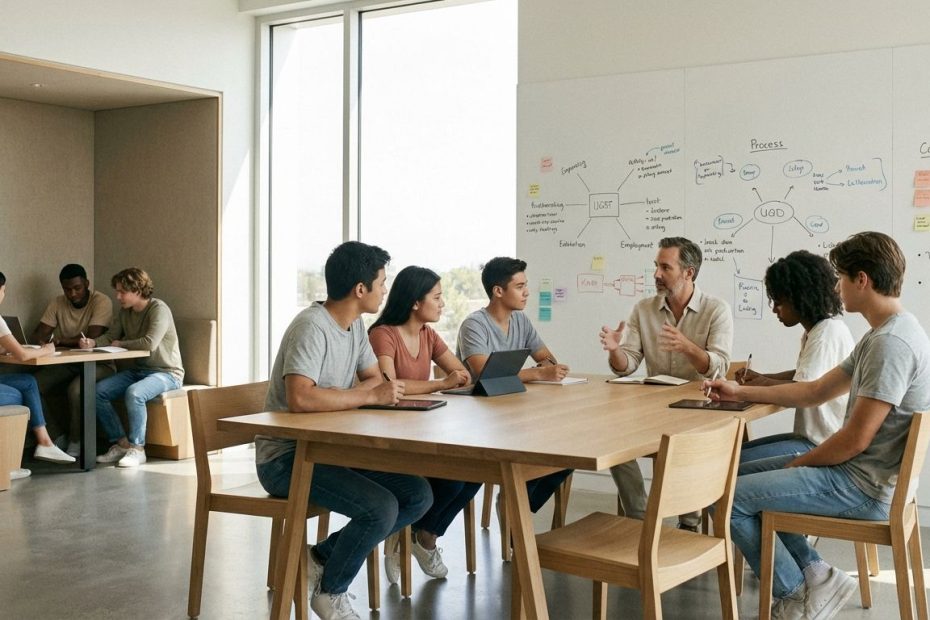
Flipped classrooms engage students by moving basic content review outside class and turning live class time into guided practice, discussion, problem-solving, and feedback. When you design them well, students spend less time sitting through one-way delivery and more time actively working through the material with support.
If you want students to participate more, prepare better, and retain more of what they learn, the flipped model gives you a practical way to use class time with greater purpose. This article shows you what flipped classrooms are, why they can boost engagement, where they break down, and how you can implement them without creating confusion or resistance.
What Is A Flipped Classroom, And How Is It Different From A Traditional Lecture?
A flipped classroom changes the sequence of learning. Instead of using class time for direct instruction and sending practice home as homework, you shift initial exposure to content outside class through short videos, readings, guided notes, or brief learning modules. Then you use in-person or live class time for higher-value work: discussion, case analysis, problem-solving, peer collaboration, application, and feedback.
That difference sounds simple, but it changes the student experience in a major way. In a traditional lecture, students often sit through content delivery, leave with partial understanding, and then hit the difficult part when they are alone. In a flipped model, the difficult part happens when you are present and able to guide, correct, question, and redirect in real time.
The practical shift is not just technological. A flipped classroom is not “watch a video instead of hearing a lecture.” It is a deliberate teaching design that protects class time for active learning. Students arrive with a base level of exposure, then use class to process, test, apply, and strengthen that knowledge under structured conditions.
That is why the flipped model connects so closely with active learning strategies. The strongest versions of flipped teaching do not rely on content delivery tools alone. They rely on what you do with the reclaimed classroom minutes. If students spend that time solving real problems, comparing reasoning, asking sharper questions, and receiving immediate feedback, engagement rises for a reason students can feel.
You can also think of flipped teaching as a time-allocation decision. Classroom time is limited and expensive in every learning environment. If your students can review core content before class at their own pace, then your live time can focus on the work that benefits most from your presence. That is where flipped teaching becomes more than a format choice. It becomes a performance decision about how learning time gets used.
Do Flipped Classrooms Actually Improve Student Engagement And Learning?
In many settings, yes. Research across higher education has linked flipped classrooms with improved academic performance, stronger participation, and better use of in-class learning time. A broad meta-analysis cited in a randomized trial found an overall positive effect on academic achievement in higher education, with results varying by discipline. That variation matters, yet the larger point stands: when flipped learning is structured well, students often perform better than they do in lecture-centered environments.
Medical education research has also reported strong gains. A systematic review and meta-analysis found meaningful improvement in final knowledge scores for students in flipped formats, including positive effects in randomized controlled trials, meaning studies that compare groups under tighter research conditions. That matters if you want evidence stronger than anecdotal enthusiasm.
Engagement often improves for a practical reason rather than a mystical one. Students have more to do during class. They discuss, debate, calculate, draft, revise, interpret, and defend their thinking. That activity level naturally creates more visible participation than passive note-taking. You are not hoping students stay engaged. You are giving them work that requires engagement.
Still, results are never automatic. A weak flipped course can underperform a strong lecture course. If the pre-class material is too long, too vague, or disconnected from class activity, students stop seeing the value. If the in-class work feels like busywork, the model loses credibility fast. Gains show up when the design is tight: short pre-work, clear expectations, structured accountability, and live activities tied directly to learning goals.
The strongest takeaway is this: flipped classrooms do not improve learning simply because lecture moves online. They improve learning when students arrive ready enough to participate and when class time is built around meaningful application. The engine is active use of knowledge, not the video itself.
Why Are Flipped Classrooms More Engaging For Some Students?
Students tend to engage more when they are doing visible intellectual work in the room instead of waiting for information to be delivered to them. In a flipped classroom, they arrive with baseline familiarity and spend class time applying concepts, asking questions, and getting corrected before misunderstandings harden. That structure can make learning feel more immediate and less abstract.
Another reason engagement rises is timing. In a lecture model, confusion often appears later, usually during homework, when students are on their own. In a flipped model, confusion shows up during class. That allows you to address it in the moment, not after the student has already practiced the wrong method or given up. Students often interpret that kind of support as better teaching because the help arrives when they need it most.
Flipped classrooms also create more room for interaction. Students speak more, compare answers, challenge assumptions, and learn from peer reasoning. The room becomes less centered on listening and more centered on thinking aloud, making decisions, and refining responses. That shift can draw in students who rarely contribute during lecture-heavy sessions but respond well when given a task and a clear role.
Pacing also matters. Pre-class material can often be paused, replayed, annotated, or reviewed on a student’s own schedule. That control is useful for learners who need a little more time to process unfamiliar content before entering a live setting. Once class begins, they are not encountering the material cold. They are working from prior exposure, which often increases confidence and willingness to participate.
Engagement is rarely about entertainment. It is about relevance, structure, and action. Students engage more when they know what they are supposed to do, why it matters, and how the classroom helps them do it better. Flipped learning supports that pattern when you build each class around purposeful activity rather than content repetition.
What Are The Biggest Challenges Of The Flipped Classroom?
The largest challenge is pre-class preparation. If students do not complete the assigned video, reading, or guided task, the class session loses momentum before it begins. The activities that make flipped learning effective depend on some minimum level of readiness. Without that, discussion gets shallow, group work stalls, and you end up reteaching content instead of extending it.
The second major challenge is instructor workload. Designing a strong flipped course takes planning. You need concise pre-class material, tight instructions, useful accountability checks, and in-class tasks that move beyond recap. That is more front-loaded work than walking into a room and delivering a lecture. The payoff can be substantial, but the setup is real, and underestimating it creates weak execution.
Student perception is another pressure point. Some students see flipped learning as extra work or as a signal that the instructor is stepping back from teaching. That reaction gets stronger when the outside-of-class materials are too long or when the in-class tasks feel disconnected from the assigned preparation. If students cannot see the relationship between the pre-work and the classroom payoff, resistance grows fast.
There are also practical equity concerns in many settings. Students may have inconsistent access to quiet study time, devices, or stable routines. In some courses, the issue is not access but overload. Students already juggling multiple deadlines can fall behind when pre-class tasks pile up. That means your flipped design must be disciplined. Shorter, more focused preparation usually performs better than dumping full lectures into homework space.
Another challenge is that instructors sometimes flip the wrong material. Not every topic belongs outside class. Students still need direct explanation at times, especially when the concept is dense, unfamiliar, or likely to trigger misconceptions. Strong flipped teaching does not eliminate instruction. It relocates part of it and preserves live time for the moments where guidance matters most.
Why Do Some Students Resist Flipped Classrooms?
Students often resist flipped classrooms because the model changes what they think school is supposed to look like. Many have spent years equating teaching with live explanation from the front of the room. When that familiar structure changes, some assume they are being asked to teach themselves. That reaction is emotional before it is analytical, and it can shape the course climate quickly.
Resistance also rises when the workload feels badly balanced. If students are assigned long pre-class videos and then still receive a mini-lecture in class before beginning activities, they start to feel they are doing double the work for the same content. Once that perception sets in, even well-designed class activities can feel like an added burden rather than a learning advantage.
Some research on flipped learning has pointed directly to student resistance as a recurring issue, even in courses where academic outcomes improved. That gap between performance and perception is important. Students do not always enjoy the methods that help them learn better, especially when those methods demand more preparation and visible participation.
Community discussions among teachers and professors echo the same pattern. Common complaints include students not watching videos, arriving unprepared, or saying the model favors self-directed learners. These reports are anecdotal, yet they line up with formal research that identifies pre-class compliance and adaptation as major success factors.
You reduce resistance by making the model legible. Students need to understand what they are doing before class, what happens with that preparation during class, and how the design helps them perform better. When they can see the return on their effort, buy-in improves. When they cannot, the flipped model feels like extra labor with no clear reward.
How Can You Make A Flipped Classroom Work In Practice?
You make a flipped classroom work by tightening every part of the learning sequence. Start with the content that students can absorb independently with a reasonable amount of support. Keep that material short, focused, and directly tied to what they will do in class. If the pre-work takes too long or covers too much, completion drops and resentment rises.
Then build accountability into the opening minutes of class. A short quiz, a quick poll, a written prompt, a problem set starter, or a brief reflection question makes preparation visible. That step does more than check compliance. It tells students that the pre-work matters and gives you real-time data about what they understood before you launch into application.
Your in-class tasks need to justify the entire model. Use the live session for work students cannot do as effectively alone: complex problem-solving, case analysis, peer critique, discussion of misconceptions, guided practice, drafting and revision, simulations, or team-based application. If the room simply repeats the pre-class material, the structure collapses.
It also helps to start small. You do not need to redesign an entire semester at once. Flip one lesson, one unit, or one recurring class segment. Measure preparation rates, participation, confusion points, and performance patterns. Then refine the design before expanding. That is the fastest way to build a model that matches your students instead of forcing them into a template.
Communication matters at every stage. Tell students what to do, how long it should take, what they need to bring into class, and how that preparation will be used. Keep directions plain. Keep deadlines consistent. Keep class routines familiar enough that students can spend their energy on learning rather than decoding logistics.
You should also decide where direct instruction still belongs. Short live clarification moments can strengthen flipped learning when they are targeted and responsive. Students do not need less teaching. They need teaching delivered at the moment it has the most value. That shift is where many flipped classrooms either succeed or fail.
Is Flipped Learning Better For College Students Than For Kindergarten Through Twelfth Grade Students?
Flipped learning is not automatically better for college students, but it is often easier to implement with learners who have stronger self-management skills. College students may be more accustomed to independent reading, self-paced review, and preparation before class. That can make the model more stable, especially in courses where students already expect to learn some material outside scheduled meetings.
In kindergarten through twelfth grade settings, the model can still work well, but the scaffolding has to be tighter. Students may need shorter pre-class material, guided note sheets, parent-facing instructions, classroom reminders, and consistent routines that reduce the odds of missed preparation. Younger learners also benefit from faster feedback loops, which means teachers need simple ways to check readiness early and often.
Access also matters more in school settings where home technology conditions vary. A flipped design that assumes every student has uninterrupted device access and quiet homework time will break down quickly. That does not rule out flipping. It means the model has to be built around realistic constraints, not ideal ones.
Research across disciplines suggests the question is less about age and more about implementation quality. A well-scaffolded school-level flipped lesson can outperform a poorly designed college version. Students adapt when expectations are clear, material is manageable, and classroom time pays off in visible ways.
If you work with younger students, the main adjustment is not to water the model down. It is to structure it with more precision. Shorter inputs, more guided support, clearer transitions, and frequent checks can make flipped learning usable well before college. What changes is the amount of support you wrap around the sequence.
How Do You Measure Whether A Flipped Classroom Is Actually Working?
You measure a flipped classroom by tracking more than test scores. Start with preparation rates. Are students completing the assigned pre-class work, and are they completing it at a level that allows meaningful participation? If completion is low, the issue may not be motivation alone. It may signal that the assignment is too long, too vague, or too easy to ignore.
Then examine class quality. Look at participation patterns, the quality of discussion, the level of questions students ask, and the amount of time spent reteaching basics. In a functioning flipped classroom, you should see less passive waiting and more visible application. Students should spend more time producing answers, defending decisions, and correcting errors with support.
Performance data matters too, but it should be interpreted carefully. Compare quiz results, project quality, exam performance, and retention of key ideas over time. If scores rise but students remain resistant, you may need stronger communication and cleaner pacing. If students enjoy class more but performance stays flat, the in-class tasks may feel active without being rigorous enough.
Feedback from students can help if you ask the right questions. Do they understand the purpose of the pre-work? Does class time feel useful? Are instructions clear? Which assignments support preparation best? General questions about whether they “like” the model are less useful than targeted questions about effort, clarity, and payoff.
You should also review your own workload and sustainability. A flipped classroom that looks effective for two weeks but burns out the instructor by midterm is not a stable design. The goal is a repeatable model that produces better learning conditions without creating operational chaos. Strong teaching has to scale across a real calendar, not just a promising pilot.
What Makes A Flipped Classroom More Engaging?
- Students review basics before class.
- Class time focuses on discussion, problem-solving, and feedback.
- You catch confusion earlier and increase active participation.
Turn Class Time Into The Part Students Cannot Miss
Flipped classrooms engage students when you use them with precision, not when you treat them as a trend. The model works best when pre-class preparation is short, purposeful, and directly connected to demanding in-class activity. Students respond when they can see that class time helps them solve problems, test ideas, and improve faster than they could on their own. If you want stronger participation, better use of live teaching time, and more active learning, flipped instruction gives you a practical route there. Build it carefully, explain it clearly, measure it honestly, and your classroom becomes a place where students do the real work of learning in the room, not after they leave it.
References
- https://teachingcommons.stanford.edu/teaching-guides/blended-and-hybrid-teaching-guide/frameworks-blended-and-hybrid-teaching/flipped
- https://www.cmu.edu/teaching/technology/flippingtheclass/index.html
- https://www.cmu.edu/teaching/resources/instructionalstrategies/activelearningstrategies/index.html
- https://link.springer.com/article/10.1186/s41239-023-00413-6
- https://www.jmir.org/2025/1/e60757
- https://www.mdpi.com/2227-7102/13/4/396
- https://www.sciencedirect.com/science/article/pii/S1747938X19301599
- https://www.reddit.com/r/Teachers/comments/1mlqxce
- https://www.reddit.com/r/Professors/comments/1ln3xw1
- https://www.reddit.com/r/Teachers/comments/1oyma4v/so_tired_of_the_flipped_classroom/

Nirdosh Jagota is Managing Partner at GRQ Biotech Advisors with 30+ years in the biotech industry. A former executive at Amgen, Genentech/Roche, Merck, and Pfizer, he has led >25 NDAs/BLAs/MAAs and hundreds of INDs across global regulatory, quality, and compliance.